This free German A1 vocabulary list contains the 1000 most useful words for beginner learners – each with its article (der, die, das), plural or verb forms, the English meaning and an example sentence with translation. The words are sorted into 18 topics and chosen for everyday life and for the A1 exams: Goethe-Zertifikat A1: Start Deutsch 1, telc Deutsch A1 and ÖSD Zertifikat A1.
Download the A1 word list
- Colour-coded articles, plurals and verb forms
- An example sentence with translation for every word
- 20-day study plan with spaced repetition and progress tracker
- Quick checks after each topic, final test and answer keys
- A–Z index and QR codes to the online version
How to learn these 1000 words
- Learn 50 words a day – the list is split into 20 daily blocks.
- Always learn nouns with their article and plural; the colours help: der blue, die red, das green.
- Say every word aloud in its example sentence – press ▶ to hear it.
- Review each block after 1, 3 and 7 days, and test yourself with the “Hide English” switch.
Greetings and basics German A1 vocabulary · 58 words
| # | German | Plural / forms | English | Example |
|---|---|---|---|---|
| 1 | Hallo | hello | Hallo, wie geht's? Hello, how are you? | |
| 2 | Guten Morgen | good morning | Guten Morgen, Frau Schmidt! Good morning, Mrs Schmidt! | |
| 3 | Guten Tag | good day; hello | Guten Tag, mein Name ist Weber. Hello, my name is Weber. | |
| 4 | Guten Abend | good evening | Guten Abend, Herr Bauer! Good evening, Mr Bauer! | |
| 5 | Gute Nacht | good night | Gute Nacht und schlaf gut! Good night and sleep well! | |
| 6 | Tschüss | bye | Tschüss, bis morgen! Bye, see you tomorrow! | |
| 7 | Auf Wiedersehen | goodbye | Auf Wiedersehen und vielen Dank! Goodbye and thank you very much! | |
| 8 | Bis später | see you later | Ich muss los. Bis später! I have to go. See you later! | |
| 9 | Bis morgen | see you tomorrow | Schönen Abend noch, bis morgen! Have a nice evening, see you tomorrow! | |
| 10 | Bis bald | see you soon | Ruf mich an! Bis bald! Call me! See you soon! | |
| 11 | Danke | thank you; thanks | Danke für die Hilfe! Thanks for the help! | |
| 12 | Danke schön | thank you very much | Danke schön, das ist sehr nett. Thank you very much, that's very kind. | |
| 13 | Vielen Dank | many thanks | Vielen Dank für die Einladung! Many thanks for the invitation! | |
| 14 | bitte | please; you're welcome | Einen Kaffee, bitte. A coffee, please. | |
| 15 | die Entschuldigung | Pl. Entschuldigungen | excuse me; apology | Entschuldigung, wo ist der Bahnhof? Excuse me, where is the station? |
| 16 | Tut mir leid | I'm sorry | Tut mir leid, ich habe keine Zeit. I'm sorry, I don't have time. | |
| 17 | Wie geht's? | how are you? (informal) | Hallo Anna, wie geht's? Hi Anna, how are you? | |
| 18 | Wie geht es Ihnen? | how are you? (formal) | Guten Tag, Herr Kraus, wie geht es Ihnen? Hello, Mr Kraus, how are you? | |
| 19 | Freut mich | nice to meet you | Ich bin Tom. – Freut mich! I'm Tom. – Nice to meet you! | |
| 20 | Herzlich willkommen | welcome | Herzlich willkommen in Berlin! Welcome to Berlin! | |
| 21 | ja | yes | Ja, das ist richtig. Yes, that is correct. | |
| 22 | nein | no | Nein, ich komme nicht mit. No, I'm not coming along. | |
| 23 | doch | yes (contradicting a negative); but | Kommst du nicht? – Doch! Aren't you coming? – Yes, I am! | |
| 24 | vielleicht | maybe; perhaps | Vielleicht komme ich morgen. Maybe I'll come tomorrow. | |
| 25 | der Herr | Pl. Herren | Mr; gentleman | Herr Müller ist unser Lehrer. Mr Müller is our teacher. |
| 26 | die Frau | Pl. Frauen | woman; Mrs/Ms; wife | Frau Schulz wohnt im zweiten Stock. Mrs Schulz lives on the second floor. |
| 27 | der Gruß | Pl. Grüße | greeting | Viele Grüße aus Hamburg! Best wishes from Hamburg! |
| 28 | die Hilfe | Pl. Hilfen | help | Brauchen Sie Hilfe? Do you need help? |
| 29 | der Moment | Pl. Momente | moment | Einen Moment, bitte! One moment, please! |
| 30 | die Frage | Pl. Fragen | question | Ich habe eine Frage. I have a question. |
| 31 | die Antwort | Pl. Antworten | answer | Danke für deine Antwort! Thanks for your answer! |
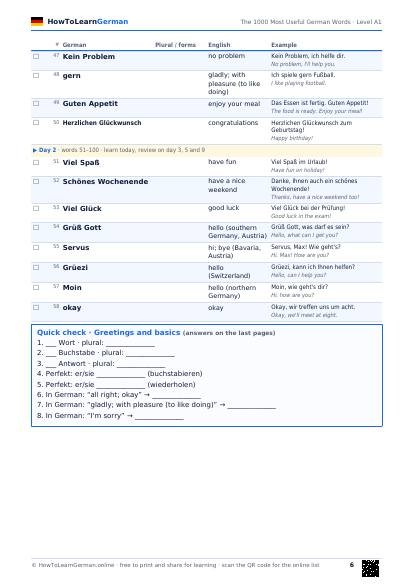
| 32 | das Wort | Pl. Wörter | word | Ich kenne das Wort nicht. I don't know the word. |
| 33 | die Sprache | Pl. Sprachen | language | Welche Sprachen sprechen Sie? Which languages do you speak? |
| 34 | das Deutsch | no plural | German (language) | Ich lerne seit drei Monaten Deutsch. I've been learning German for three months. |
| 35 | das Englisch | no plural | English (language) | Sprechen Sie Englisch? Do you speak English? |
| 36 | sprechen | spricht, sprach, hat gesprochen | to speak | Sie spricht sehr gut Deutsch. She speaks German very well. |
| 37 | verstehen | versteht, verstand, hat verstanden | to understand | Ich verstehe das nicht. I don't understand that. |
| 38 | wiederholen | wiederholt, wiederholte, hat wiederholt | to repeat | Können Sie das bitte wiederholen? Can you repeat that, please? |
| 39 | buchstabieren | buchstabiert, buchstabierte, hat buchstabiert | to spell | Können Sie Ihren Namen buchstabieren? Can you spell your name? |
| 40 | heißen | heißt, hieß, hat geheißen | to be called | Ich heiße Maria. My name is Maria. |
| 41 | der Satz | Pl. Sätze | sentence | Schreib bitte einen Satz. Please write a sentence. |
| 42 | der Buchstabe | Pl. Buchstaben | letter (of the alphabet) | Das Wort hat fünf Buchstaben. The word has five letters. |
| 43 | das Beispiel | Pl. Beispiele | example | Hier ist ein Beispiel. Here is an example. |
| 44 | zum Beispiel | for example | Ich esse gern Obst, zum Beispiel Äpfel. I like eating fruit, for example apples. | |
| 45 | Wie bitte? | pardon?; sorry? | Wie bitte? Ich habe das nicht verstanden. Pardon? I didn't understand that. | |
| 46 | Alles klar | all right; okay | Alles klar, bis morgen! All right, see you tomorrow! | |
| 47 | Kein Problem | no problem | Kein Problem, ich helfe dir. No problem, I'll help you. | |
| 48 | gern | gladly; with pleasure (to like doing) | Ich spiele gern Fußball. I like playing football. | |
| 49 | Guten Appetit | enjoy your meal | Das Essen ist fertig. Guten Appetit! The food is ready. Enjoy your meal! | |
| 50 | Herzlichen Glückwunsch | congratulations | Herzlichen Glückwunsch zum Geburtstag! Happy birthday! | |
| 51 | Viel Spaß | have fun | Viel Spaß im Urlaub! Have fun on holiday! | |
| 52 | Schönes Wochenende | have a nice weekend | Danke, Ihnen auch ein schönes Wochenende! Thanks, have a nice weekend too! | |
| 53 | Viel Glück | good luck | Viel Glück bei der Prüfung! Good luck in the exam! | |
| 54 | Grüß Gott | hello (southern Germany, Austria) | Grüß Gott, was darf es sein? Hello, what can I get you? | |
| 55 | Servus | hi; bye (Bavaria, Austria) | Servus, Max! Wie geht's? Hi, Max! How are you? | |
| 56 | Grüezi | hello (Switzerland) | Grüezi, kann ich Ihnen helfen? Hello, can I help you? | |
| 57 | Moin | hello (northern Germany) | Moin, wie geht's dir? Hi, how are you? | |
| 58 | okay | okay | Okay, wir treffen uns um acht. Okay, we'll meet at eight. |
Personal details German A1 vocabulary · 52 words
| # | German | Plural / forms | English | Example |
|---|---|---|---|---|
| 59 | der Name | Pl. Namen | name | Wie ist Ihr Name? What is your name? |
| 60 | der Vorname | Pl. Vornamen | first name | Mein Vorname ist Peter. My first name is Peter. |
| 61 | der Familienname | Pl. Familiennamen | surname; family name | Wie ist Ihr Familienname? What is your surname? |
| 62 | der Nachname | Pl. Nachnamen | surname; last name | Schreiben Sie hier Ihren Nachnamen. Write your last name here. |
| 63 | die Adresse | Pl. Adressen | address | Wie ist deine Adresse? What is your address? |
| 64 | die Hausnummer | Pl. Hausnummern | house number | Die Hausnummer ist zwölf. The house number is twelve. |
| 65 | die Postleitzahl | Pl. Postleitzahlen | postcode; zip code | Wie ist die Postleitzahl? What is the postcode? |
| 66 | der Wohnort | Pl. Wohnorte | place of residence | Mein Wohnort ist Köln. I live in Cologne. |
| 67 | die Telefonnummer | Pl. Telefonnummern | telephone number | Hast du meine Telefonnummer? Do you have my phone number? |
| 68 | die Handynummer | Pl. Handynummern | mobile number | Gib mir bitte deine Handynummer. Please give me your mobile number. |
| 69 | die E-Mail | Pl. E-Mails | Ich schreibe dir eine E-Mail. I'll write you an email. | |
| 70 | das Alter | no plural | age | Alter: 25 Jahre. Age: 25 years. |
| 71 | der Geburtstag | Pl. Geburtstage | birthday | Wann hast du Geburtstag? When is your birthday? |
| 72 | der Geburtsort | Pl. Geburtsorte | place of birth | Mein Geburtsort ist Wien. My place of birth is Vienna. |
| 73 | das Geburtsdatum | Pl. Geburtsdaten | date of birth | Bitte schreiben Sie Ihr Geburtsdatum hier. Please write your date of birth here. |
| 74 | geboren | born | Ich bin 1995 in Polen geboren. I was born in Poland in 1995. | |
| 75 | das Land | Pl. Länder | country; countryside | Aus welchem Land kommst du? Which country are you from? |
| 76 | das Deutschland | no plural | Germany | Wir wohnen seit zwei Jahren in Deutschland. We have lived in Germany for two years. |
| 77 | das Österreich | no plural | Austria | Wien ist die Hauptstadt von Österreich. Vienna is the capital of Austria. |
| 78 | die Schweiz | no plural | Switzerland | Mein Bruder arbeitet in der Schweiz. My brother works in Switzerland. |
| 79 | das Europa | no plural | Europe | Spanien liegt in Europa. Spain is in Europe. |
| 80 | der/die Deutsche | Pl. Deutsche | German (person) | Mein Mann ist Deutscher. My husband is German. |
| 81 | deutsch | German | Ich mag das deutsche Brot. I like German bread. | |
| 82 | der Ausländer | Pl. Ausländer | foreigner | In der Stadt leben viele Ausländer. Many foreigners live in the city. |
| 83 | die Staatsangehörigkeit | Pl. Staatsangehörigkeiten | nationality; citizenship | Staatsangehörigkeit: italienisch. Nationality: Italian. |
| 84 | die Nationalität | Pl. Nationalitäten | nationality | Welche Nationalität haben Sie? What nationality are you? |
| 85 | kommen | kommt, kam, ist gekommen | to come | Ich komme aus der Türkei. I come from Turkey. |
| 86 | wohnen | wohnt, wohnte, hat gewohnt | to live (reside) | Wo wohnst du? Where do you live? |
| 87 | leben | lebt, lebte, hat gelebt | to live | Meine Eltern leben in Italien. My parents live in Italy. |
| 88 | der Familienstand | no plural | marital status | Familienstand: ledig. Marital status: single. |
| 89 | ledig | single (not married) | Ich bin ledig und habe keine Kinder. I'm single and have no children. | |
| 90 | verheiratet | married | Sind Sie verheiratet? Are you married? | |
| 91 | geschieden | divorced | Meine Eltern sind geschieden. My parents are divorced. | |
| 92 | das Formular | Pl. Formulare | form | Bitte füllen Sie das Formular aus. Please fill in the form. |
| 93 | aus·füllen | füllt aus, füllte aus, hat ausgefüllt | to fill in; to fill out | Ich fülle den Antrag aus. I'm filling in the application. |
| 94 | unterschreiben | unterschreibt, unterschrieb, hat unterschrieben | to sign | Unterschreiben Sie bitte hier. Please sign here. |
| 95 | die Unterschrift | Pl. Unterschriften | signature | Hier fehlt noch Ihre Unterschrift. Your signature is still missing here. |
| 96 | der Ausweis | Pl. Ausweise | ID card | Haben Sie Ihren Ausweis dabei? Do you have your ID with you? |
| 97 | der Pass | Pl. Pässe | passport | Mein Pass ist noch zwei Jahre gültig. My passport is valid for two more years. |
| 98 | männlich | male | Geschlecht: männlich. Sex: male. | |
| 99 | weiblich | female | Geschlecht: weiblich. Sex: female. | |
| 100 | die Muttersprache | Pl. Muttersprachen | mother tongue; native language | Meine Muttersprache ist Arabisch. My native language is Arabic. |
| 101 | sich vor·stellen | stellt sich vor, stellte sich vor, hat sich vorgestellt | to introduce oneself | Darf ich mich vorstellen? May I introduce myself? |
| 102 | die Information | Pl. Informationen | information | Hier finden Sie alle Informationen. Here you'll find all the information. |
| 103 | die Person | Pl. Personen | person | Wir sind vier Personen. We are four people. |
| 104 | die Leute | plural only | people | Die Leute hier sind sehr nett. The people here are very nice. |
| 105 | der Mensch | Pl. Menschen | human being; person | In Berlin leben viele Menschen. Many people live in Berlin. |
| 106 | der Ort | Pl. Orte | place; village | Der Ort ist sehr klein. The place is very small. |
| 107 | die Nummer | Pl. Nummern | number | Welche Nummer hat das Zimmer? What number does the room have? |
| 108 | die Anmeldung | Pl. Anmeldungen | registration | Die Anmeldung ist im ersten Stock. Registration is on the first floor. |
| 109 | sich an·melden | meldet sich an, meldete sich an, hat sich angemeldet | to register; to sign up | Ich melde mich für den Kurs an. I'm signing up for the course. |
| 110 | der Kurs | Pl. Kurse | course; class | Der Kurs beginnt am Montag. The course starts on Monday. |
Family and friends German A1 vocabulary · 49 words
| # | German | Plural / forms | English | Example |
|---|---|---|---|---|
| 111 | die Familie | Pl. Familien | family | Meine Familie wohnt in Frankfurt. My family lives in Frankfurt. |
| 112 | die Eltern | plural only | parents | Meine Eltern sind Lehrer. My parents are teachers. |
| 113 | der Vater | Pl. Väter | father | Mein Vater arbeitet in einer Bank. My father works in a bank. |
| 114 | die Mutter | Pl. Mütter | mother | Meine Mutter kocht sehr gut. My mother cooks very well. |
| 115 | der Papa | Pl. Papas | dad | Papa, kannst du mir helfen? Dad, can you help me? |
| 116 | die Mama | Pl. Mamas | mum; mom | Mama ist heute nicht zu Hause. Mum isn't at home today. |
| 117 | das Kind | Pl. Kinder | child | Wir haben zwei Kinder. We have two children. |
| 118 | der Sohn | Pl. Söhne | son | Unser Sohn ist acht Jahre alt. Our son is eight years old. |
| 119 | die Tochter | Pl. Töchter | daughter | Ihre Tochter studiert in München. Her daughter studies in Munich. |
| 120 | der Bruder | Pl. Brüder | brother | Mein Bruder wohnt in Hamburg. My brother lives in Hamburg. |
| 121 | die Schwester | Pl. Schwestern | sister | Hast du eine Schwester? Do you have a sister? |
| 122 | die Geschwister | plural only | siblings | Hast du Geschwister? Do you have any brothers or sisters? |
| 123 | die Großeltern | plural only | grandparents | Am Sonntag besuchen wir die Großeltern. On Sunday we visit our grandparents. |
| 124 | der Großvater | Pl. Großväter | grandfather | Mein Großvater ist 80 Jahre alt. My grandfather is 80 years old. |
| 125 | die Großmutter | Pl. Großmütter | grandmother | Meine Großmutter wohnt auf dem Land. My grandmother lives in the country. |
| 126 | der Opa | Pl. Opas | grandpa | Opa liest jeden Morgen die Zeitung. Grandpa reads the newspaper every morning. |
| 127 | die Oma | Pl. Omas | grandma | Oma macht den besten Kuchen. Grandma makes the best cake. |
| 128 | der Enkel | Pl. Enkel | grandson; grandchild | Die Großeltern spielen mit ihrem Enkel. The grandparents are playing with their grandson. |
| 129 | der Onkel | Pl. Onkel | uncle | Mein Onkel hat ein Restaurant. My uncle has a restaurant. |
| 130 | die Tante | Pl. Tanten | aunt | Meine Tante wohnt in Österreich. My aunt lives in Austria. |
| 131 | der Cousin | Pl. Cousins | cousin (male) | Mein Cousin ist auch 20. My cousin is also 20. |
| 132 | die Cousine | Pl. Cousinen | cousin (female) | Meine Cousine heiratet im Mai. My cousin is getting married in May. |
| 133 | der Mann | Pl. Männer | man; husband | Mein Mann heißt Stefan. My husband is called Stefan. |
| 134 | der Ehemann | Pl. Ehemänner | husband | Ihr Ehemann ist Arzt. Her husband is a doctor. |
| 135 | die Ehefrau | Pl. Ehefrauen | wife | Das ist meine Ehefrau Lena. This is my wife Lena. |
| 136 | der Partner | Pl. Partner | partner (male) | Wohnst du mit deinem Partner zusammen? Do you live with your partner? |
| 137 | die Partnerin | Pl. Partnerinnen | partner (female) | Er kommt mit seiner Partnerin. He's coming with his partner. |
| 138 | der Freund | Pl. Freunde | friend; boyfriend | Mein Freund kommt aus Spanien. My friend comes from Spain. |
| 139 | die Freundin | Pl. Freundinnen | friend (female); girlfriend | Ich gehe mit meiner Freundin ins Kino. I'm going to the cinema with my girlfriend. |
| 140 | das Baby | Pl. Babys | baby | Das Baby schläft gerade. The baby is sleeping right now. |
| 141 | der Junge | Pl. Jungen | boy | Der Junge spielt im Garten. The boy is playing in the garden. |
| 142 | das Mädchen | Pl. Mädchen | girl | Das Mädchen ist sechs Jahre alt. The girl is six years old. |
| 143 | der Nachbar | Pl. Nachbarn | neighbour (male) | Unser Nachbar ist sehr freundlich. Our neighbour is very friendly. |
| 144 | die Nachbarin | Pl. Nachbarinnen | neighbour (female) | Meine Nachbarin hat einen Hund. My neighbour has a dog. |
| 145 | die Hochzeit | Pl. Hochzeiten | wedding | Die Hochzeit ist im Juni. The wedding is in June. |
| 146 | heiraten | heiratet, heiratete, hat geheiratet | to marry; to get married | Wir heiraten im Sommer. We're getting married in the summer. |
| 147 | lieben | liebt, liebte, hat geliebt | to love | Ich liebe dich. I love you. |
| 148 | die Liebe | no plural | love | Liebe ist das Wichtigste. Love is the most important thing. |
| 149 | der Gast | Pl. Gäste | guest | Wir haben heute Abend Gäste. We have guests this evening. |
| 150 | besuchen | besucht, besuchte, hat besucht | to visit | Ich besuche am Wochenende meine Eltern. I'm visiting my parents at the weekend. |
| 151 | der Besuch | Pl. Besuche | visit; visitors | Morgen bekommen wir Besuch. We're getting visitors tomorrow. |
| 152 | ein·laden | lädt ein, lud ein, hat eingeladen | to invite | Ich lade dich zum Essen ein. I'm inviting you for a meal. |
| 153 | die Einladung | Pl. Einladungen | invitation | Danke für die Einladung! Thanks for the invitation! |
| 154 | feiern | feiert, feierte, hat gefeiert | to celebrate; to party | Wir feiern am Samstag meinen Geburtstag. We're celebrating my birthday on Saturday. |
| 155 | das Geschenk | Pl. Geschenke | present; gift | Das Geschenk ist für dich. The present is for you. |
| 156 | der/die Erwachsene | Pl. Erwachsene | adult | Der Eintritt kostet für Erwachsene zehn Euro. Admission costs ten euros for adults. |
| 157 | allein | alone; on one's own | Ich wohne allein. I live alone. | |
| 158 | zusammen | together | Wir kochen heute zusammen. We're cooking together today. | |
| 159 | der Kindergarten | Pl. Kindergärten | nursery school; kindergarten | Meine Tochter geht in den Kindergarten. My daughter goes to nursery school. |
Numbers, time and dates German A1 vocabulary · 119 words
| # | German | Plural / forms | English | Example |
|---|---|---|---|---|
| 160 | null | zero | Meine Nummer beginnt mit null. My number begins with zero. | |
| 161 | eins | one | Eins plus eins ist zwei. One plus one is two. | |
| 162 | zwei | two | Ich habe zwei Brüder. I have two brothers. | |
| 163 | drei | three | Das Kind ist drei Jahre alt. The child is three years old. | |
| 164 | vier | four | Wir sind vier Personen. Haben Sie Platz? We are four people. Do you have room? | |
| 165 | fünf | five | Der Bus kommt in fünf Minuten. The bus comes in five minutes. | |
| 166 | sechs | six | Ich stehe um sechs Uhr auf. I get up at six o'clock. | |
| 167 | sieben | seven | Eine Woche hat sieben Tage. A week has seven days. | |
| 168 | acht | eight | Der Kurs beginnt um acht. The course begins at eight. | |
| 169 | neun | nine | Der Supermarkt öffnet um neun Uhr. The supermarket opens at nine o'clock. | |
| 170 | zehn | ten | Das kostet zehn Euro. That costs ten euros. | |
| 171 | elf | eleven | Der Zug fährt um elf Uhr. The train leaves at eleven o'clock. | |
| 172 | zwölf | twelve | Ein Jahr hat zwölf Monate. A year has twelve months. | |
| 173 | dreizehn | thirteen | Mein Sohn ist dreizehn. My son is thirteen. | |
| 174 | vierzehn | fourteen | Der Kurs dauert vierzehn Tage. The course lasts fourteen days. | |
| 175 | fünfzehn | fifteen | Die Pause dauert fünfzehn Minuten. The break lasts fifteen minutes. | |
| 176 | sechzehn | sixteen | Meine Schwester ist sechzehn Jahre alt. My sister is sixteen years old. | |
| 177 | siebzehn | seventeen | Der Bus kommt um siebzehn Uhr. The bus comes at 5 p.m. | |
| 178 | achtzehn | eighteen | Mit achtzehn darf man Auto fahren. At eighteen you're allowed to drive. | |
| 179 | neunzehn | nineteen | In der Klasse sind neunzehn Schüler. There are nineteen pupils in the class. | |
| 180 | zwanzig | twenty | Ich warte schon zwanzig Minuten. I've been waiting for twenty minutes. | |
| 181 | einundzwanzig | twenty-one | Er ist einundzwanzig Jahre alt. He is twenty-one years old. | |
| 182 | dreißig | thirty | Das Zimmer hat dreißig Quadratmeter. The room is thirty square metres. | |
| 183 | vierzig | forty | Mein Vater ist vierzig. My father is forty. | |
| 184 | fünfzig | fifty | Die Schuhe kosten fünfzig Euro. The shoes cost fifty euros. | |
| 185 | sechzig | sixty | Eine Stunde hat sechzig Minuten. An hour has sixty minutes. | |
| 186 | siebzig | seventy | Meine Oma ist siebzig Jahre alt. My grandma is seventy years old. | |
| 187 | achtzig | eighty | Er fährt achtzig Kilometer pro Stunde. He's driving eighty kilometres per hour. | |
| 188 | neunzig | ninety | Das Ticket kostet neunzig Euro. The ticket costs ninety euros. | |
| 189 | hundert | hundred | Das Haus ist über hundert Jahre alt. The house is over a hundred years old. | |
| 190 | tausend | thousand | Das Auto kostet fünftausend Euro. The car costs five thousand euros. | |
| 191 | die Million | Pl. Millionen | million | Berlin hat fast vier Millionen Einwohner. Berlin has almost four million inhabitants. |
| 192 | erste | first | Ich wohne im ersten Stock. I live on the first floor. | |
| 193 | zweite | second | Das ist mein zweiter Deutschkurs. This is my second German course. | |
| 194 | dritte | third | Nehmen Sie die dritte Straße links. Take the third street on the left. | |
| 195 | die Zahl | Pl. Zahlen | number; figure | Schreiben Sie die Zahlen. Write the numbers. |
| 196 | der Montag | Pl. Montage | Monday | Am Montag habe ich frei. I'm off on Monday. |
| 197 | der Dienstag | Pl. Dienstage | Tuesday | Der Kurs ist am Dienstag. The course is on Tuesday. |
| 198 | der Mittwoch | Pl. Mittwoche | Wednesday | Am Mittwoch gehe ich schwimmen. On Wednesday I go swimming. |
| 199 | der Donnerstag | Pl. Donnerstage | Thursday | Hast du am Donnerstag Zeit? Do you have time on Thursday? |
| 200 | der Freitag | Pl. Freitage | Friday | Am Freitag gehen wir tanzen. On Friday we're going dancing. |
| 201 | der Samstag | Pl. Samstage | Saturday | Am Samstag kaufe ich ein. On Saturday I go shopping. |
| 202 | der Sonnabend | Pl. Sonnabende | Saturday (northern Germany) | Am Sonnabend ist der Markt geöffnet. The market is open on Saturday. |
| 203 | der Sonntag | Pl. Sonntage | Sunday | Am Sonntag schlafe ich lange. On Sunday I sleep late. |
| 204 | der Januar | no plural | January | Im Januar ist es sehr kalt. It is very cold in January. |
| 205 | der Februar | no plural | February | Mein Geburtstag ist im Februar. My birthday is in February. |
| 206 | der März | no plural | March | Im März beginnt der Frühling. Spring starts in March. |
| 207 | der April | no plural | April | Im April regnet es oft. It often rains in April. |
| 208 | der Mai | no plural | May | Der Kurs endet im Mai. The course ends in May. |
| 209 | der Juni | no plural | June | Wir heiraten im Juni. We're getting married in June. |
| 210 | der Juli | no plural | July | Im Juli haben die Kinder Ferien. The children have holidays in July. |
| 211 | der August | no plural | August | Im August fahren wir ans Meer. In August we're going to the seaside. |
| 212 | der September | no plural | September | Die Schule beginnt im September. School starts in September. |
| 213 | der Oktober | no plural | October | Im Oktober ist das Oktoberfest. The Oktoberfest is in October. |
| 214 | der November | no plural | November | Im November ist es oft grau. It's often grey in November. |
| 215 | der Dezember | no plural | December | Weihnachten ist im Dezember. Christmas is in December. |
| 216 | der Tag | Pl. Tage | day | Ich arbeite acht Stunden am Tag. I work eight hours a day. |
| 217 | die Woche | Pl. Wochen | week | Nächste Woche habe ich Urlaub. Next week I'm on holiday. |
| 218 | das Wochenende | Pl. Wochenenden | weekend | Was machst du am Wochenende? What are you doing at the weekend? |
| 219 | der Monat | Pl. Monate | month | Ich lerne seit einem Monat Deutsch. I've been learning German for a month. |
| 220 | das Jahr | Pl. Jahre | year | Ich wohne seit einem Jahr hier. I've lived here for a year. |
| 221 | die Stunde | Pl. Stunden | hour; lesson | Der Film dauert zwei Stunden. The film lasts two hours. |
| 222 | die Minute | Pl. Minuten | minute | Warte bitte fünf Minuten! Please wait five minutes! |
| 223 | die Sekunde | Pl. Sekunden | second | Einen Moment, nur eine Sekunde! Just a moment, only a second! |
| 224 | die Uhr | Pl. Uhren | clock; watch; o'clock | Es ist drei Uhr. It's three o'clock. |
| 225 | die Uhrzeit | Pl. Uhrzeiten | time (of day) | Um welche Uhrzeit beginnt der Film? What time does the film start? |
| 226 | die Zeit | Pl. Zeiten | time | Ich habe heute keine Zeit. I don't have time today. |
| 227 | das Datum | Pl. Daten | date | Welches Datum ist heute? What's the date today? |
| 228 | der Kalender | Pl. Kalender | calendar | Ich schreibe den Termin in den Kalender. I'll write the appointment in the calendar. |
| 229 | der Termin | Pl. Termine | appointment | Ich habe morgen einen Termin beim Arzt. I have a doctor's appointment tomorrow. |
| 230 | das Viertel | Pl. Viertel | quarter | Es ist Viertel nach acht. It's quarter past eight. |
| 231 | halb | half; half past (time) | Es ist halb neun. It's half past eight. | |
| 232 | das Mal | Pl. Male | time (occasion) | Ich bin zum ersten Mal in Berlin. I'm in Berlin for the first time. |
| 233 | Wie spät ist es? | what time is it? | Entschuldigung, wie spät ist es? Excuse me, what time is it? | |
| 234 | der Morgen | Pl. Morgen | morning | Am Morgen trinke ich Kaffee. In the morning I drink coffee. |
| 235 | der Vormittag | Pl. Vormittage | morning (before noon) | Am Vormittag arbeite ich im Büro. In the morning I work in the office. |
| 236 | der Mittag | Pl. Mittage | noon; midday | Zu Mittag esse ich in der Kantine. At lunchtime I eat in the canteen. |
| 237 | der Nachmittag | Pl. Nachmittage | afternoon | Am Nachmittag gehe ich spazieren. In the afternoon I go for a walk. |
| 238 | der Abend | Pl. Abende | evening | Am Abend sehe ich fern. In the evening I watch TV. |
| 239 | die Nacht | Pl. Nächte | night | Das Hotel kostet 80 Euro pro Nacht. The hotel costs 80 euros per night. |
| 240 | heute | today | Heute ist Montag. Today is Monday. | |
| 241 | morgen | tomorrow | Morgen habe ich frei. Tomorrow I'm off. | |
| 242 | gestern | yesterday | Gestern war ich im Kino. Yesterday I was at the cinema. | |
| 243 | übermorgen | the day after tomorrow | Übermorgen fahren wir nach Wien. The day after tomorrow we're going to Vienna. | |
| 244 | vorgestern | the day before yesterday | Vorgestern hatte ich Geburtstag. The day before yesterday was my birthday. | |
| 245 | jetzt | now | Ich habe jetzt keine Zeit. I don't have time now. | |
| 246 | gleich | right away; in a moment | Ich komme gleich! I'm coming right away! | |
| 247 | bald | soon | Der Bus kommt bald. The bus is coming soon. | |
| 248 | später | later | Ich rufe dich später an. I'll call you later. | |
| 249 | dann | then | Zuerst frühstücke ich, dann gehe ich zur Arbeit. First I have breakfast, then I go to work. | |
| 250 | danach | afterwards; after that | Danach gehen wir ins Kino. After that we're going to the cinema. | |
| 251 | vorher | before; beforehand | Ruf mich bitte vorher an! Please call me beforehand! | |
| 252 | zuerst | first; at first | Zuerst lese ich den Text. First I read the text. | |
| 253 | immer | always | Er kommt immer zu spät. He's always late. | |
| 254 | oft | often | Ich gehe oft ins Kino. I often go to the cinema. | |
| 255 | manchmal | sometimes | Manchmal fahre ich mit dem Rad. Sometimes I go by bike. | |
| 256 | nie | never | Ich trinke nie Kaffee. I never drink coffee. | |
| 257 | selten | rarely; seldom | Wir gehen selten ins Theater. We rarely go to the theatre. | |
| 258 | normalerweise | normally; usually | Normalerweise stehe ich um sieben auf. I usually get up at seven. | |
| 259 | meistens | mostly; usually | Am Abend bin ich meistens zu Hause. In the evening I'm usually at home. | |
| 260 | morgens | in the morning(s) | Morgens trinke ich immer Tee. In the mornings I always drink tea. | |
| 261 | mittags | at midday; at lunchtime | Mittags esse ich nur einen Salat. At lunchtime I only eat a salad. | |
| 262 | nachmittags | in the afternoon(s) | Nachmittags ist die Praxis geschlossen. The surgery is closed in the afternoons. | |
| 263 | abends | in the evening(s) | Abends lese ich gern. In the evenings I like reading. | |
| 264 | nachts | at night | Nachts fährt kein Bus. There's no bus at night. | |
| 265 | täglich | daily | Das Geschäft ist täglich geöffnet. The shop is open daily. | |
| 266 | früh | early | Ich stehe immer früh auf. I always get up early. | |
| 267 | spät | late | Es ist schon spät. It's already late. | |
| 268 | pünktlich | punctual; on time | Der Zug ist pünktlich. The train is on time. | |
| 269 | der Anfang | Pl. Anfänge | beginning; start | Anfang Mai habe ich Urlaub. I'm on holiday at the beginning of May. |
| 270 | das Ende | Pl. Enden | end | Am Ende der Straße ist ein Park. There is a park at the end of the street. |
| 271 | dauern | dauert, dauerte, hat gedauert | to last; to take (time) | Wie lange dauert der Kurs? How long does the course last? |
| 272 | beginnen | beginnt, begann, hat begonnen | to begin; to start | Der Film beginnt um acht. The film starts at eight. |
| 273 | an·fangen | fängt an, fing an, hat angefangen | to begin; to start | Wann fängt die Arbeit an? When does work start? |
| 274 | auf·hören | hört auf, hörte auf, hat aufgehört | to stop; to end | Der Unterricht hört um zwölf auf. Lessons end at twelve. |
| 275 | der Feiertag | Pl. Feiertage | public holiday | Am Feiertag sind die Geschäfte geschlossen. The shops are closed on public holidays. |
| 276 | das Weihnachten | Pl. Weihnachten | Christmas | Frohe Weihnachten! Merry Christmas! |
| 277 | das Ostern | Pl. Ostern | Easter | An Ostern besuchen wir die Oma. At Easter we visit grandma. |
| 278 | das Silvester | Pl. Silvester | New Year's Eve | An Silvester feiern wir mit Freunden. On New Year's Eve we celebrate with friends. |
Food and drink German A1 vocabulary · 89 words
| # | German | Plural / forms | English | Example |
|---|---|---|---|---|
| 279 | das Essen | Pl. Essen | food; meal | Das Essen ist sehr lecker. The food is very tasty. |
| 280 | essen | isst, aß, hat gegessen | to eat | Was isst du gern? What do you like to eat? |
| 281 | trinken | trinkt, trank, hat getrunken | to drink | Ich trinke einen Tee. I'm drinking a tea. |
| 282 | das Getränk | Pl. Getränke | drink; beverage | Welche Getränke haben Sie? Which drinks do you have? |
| 283 | das Frühstück | Pl. Frühstücke | breakfast | Das Frühstück ist um sieben Uhr. Breakfast is at seven o'clock. |
| 284 | frühstücken | frühstückt, frühstückte, hat gefrühstückt | to have breakfast | Wir frühstücken am Sonntag zusammen. We have breakfast together on Sunday. |
| 285 | das Mittagessen | Pl. Mittagessen | lunch | Zum Mittagessen gibt es Suppe. There's soup for lunch. |
| 286 | das Abendessen | Pl. Abendessen | dinner; supper | Das Abendessen ist fertig! Dinner is ready! |
| 287 | kochen | kocht, kochte, hat gekocht | to cook; to boil | Heute koche ich Nudeln. Today I'm cooking pasta. |
| 288 | das Brot | Pl. Brote | bread | Ich kaufe ein Brot beim Bäcker. I'm buying a loaf of bread at the baker's. |
| 289 | das Brötchen | Pl. Brötchen | bread roll | Zum Frühstück esse ich zwei Brötchen. I eat two rolls for breakfast. |
| 290 | die Butter | no plural | butter | Ich esse Brot mit Butter. I eat bread with butter. |
| 291 | der Käse | no plural | cheese | Möchtest du Käse oder Wurst? Would you like cheese or sausage? |
| 292 | die Wurst | Pl. Würste | sausage; cold meat | Die Wurst ist aus Bayern. The sausage is from Bavaria. |
| 293 | der Schinken | Pl. Schinken | ham | Ein Brötchen mit Schinken, bitte. A roll with ham, please. |
| 294 | das Fleisch | no plural | meat | Ich esse kein Fleisch. I don't eat meat. |
| 295 | das Rindfleisch | no plural | beef | Die Suppe ist mit Rindfleisch. The soup is made with beef. |
| 296 | das Schweinefleisch | no plural | pork | Ist da Schweinefleisch drin? Is there pork in it? |
| 297 | der Fisch | Pl. Fische | fish | Am Freitag gibt es Fisch. On Friday there's fish. |
| 298 | das Hähnchen | Pl. Hähnchen | chicken (food) | Ich nehme das Hähnchen mit Reis. I'll have the chicken with rice. |
| 299 | das Ei | Pl. Eier | egg | Ich esse morgens ein Ei. I eat an egg in the mornings. |
| 300 | die Milch | no plural | milk | Trinkst du Kaffee mit Milch? Do you drink coffee with milk? |
| 301 | der Joghurt | Pl. Joghurts | yoghurt | Der Joghurt ist im Kühlschrank. The yoghurt is in the fridge. |
| 302 | das Müsli | Pl. Müslis | muesli; cereal | Zum Frühstück esse ich Müsli. I eat muesli for breakfast. |
| 303 | die Marmelade | Pl. Marmeladen | jam | Die Marmelade macht meine Oma selbst. My grandma makes the jam herself. |
| 304 | der Honig | no plural | honey | Ich trinke Tee mit Honig. I drink tea with honey. |
| 305 | der Zucker | no plural | sugar | Nimmst du Zucker in den Kaffee? Do you take sugar in your coffee? |
| 306 | das Salz | no plural | salt | Die Suppe braucht noch Salz. The soup still needs salt. |
| 307 | der Pfeffer | no plural | pepper (spice) | Kannst du mir den Pfeffer geben? Can you pass me the pepper? |
| 308 | das Öl | Pl. Öle | oil | Wir brauchen noch Öl. We still need oil. |
| 309 | der Reis | no plural | rice | Zum Fisch gibt es Reis. There's rice with the fish. |
| 310 | die Nudel | Pl. Nudeln | noodle; pasta | Die Kinder essen gern Nudeln. The children like eating pasta. |
| 311 | die Kartoffel | Pl. Kartoffeln | potato | Ich koche Kartoffeln. I'm boiling potatoes. |
| 312 | die Pommes | plural only | chips; French fries | Einmal Pommes mit Ketchup, bitte. One portion of fries with ketchup, please. |
| 313 | das Gemüse | no plural | vegetables | Ich esse viel Gemüse. I eat a lot of vegetables. |
| 314 | das Obst | no plural | fruit | Obst ist gesund. Fruit is healthy. |
| 315 | der Apfel | Pl. Äpfel | apple | Ein Kilo Äpfel, bitte. A kilo of apples, please. |
| 316 | die Banane | Pl. Bananen | banana | Die Bananen sind sehr billig. The bananas are very cheap. |
| 317 | die Orange | Pl. Orangen | orange | Ich presse frische Orangen. I'm squeezing fresh oranges. |
| 318 | die Birne | Pl. Birnen | pear | Die Birne ist sehr süß. The pear is very sweet. |
| 319 | die Tomate | Pl. Tomaten | tomato | Die Tomaten sind aus Italien. The tomatoes are from Italy. |
| 320 | der Salat | Pl. Salate | salad; lettuce | Ich nehme einen Salat. I'll have a salad. |
| 321 | die Zwiebel | Pl. Zwiebeln | onion | Schneid bitte die Zwiebeln! Please cut the onions! |
| 322 | die Karotte | Pl. Karotten | carrot | Die Karotten sind aus dem Garten. The carrots are from the garden. |
| 323 | die Suppe | Pl. Suppen | soup | Die Suppe ist zu heiß. The soup is too hot. |
| 324 | der Kuchen | Pl. Kuchen | cake | Möchtest du ein Stück Kuchen? Would you like a piece of cake? |
| 325 | die Schokolade | Pl. Schokoladen | chocolate | Kinder lieben Schokolade. Children love chocolate. |
| 326 | das Eis | no plural | ice cream; ice | Im Sommer esse ich gern Eis. In summer I like eating ice cream. |
| 327 | die Pizza | Pl. Pizzen | pizza | Wir bestellen heute eine Pizza. We're ordering a pizza today. |
| 328 | die Brezel | Pl. Brezeln | pretzel | In Bayern isst man gern Brezeln. In Bavaria people like eating pretzels. |
| 329 | die Sahne | no plural | cream | Einen Kuchen mit Sahne, bitte. A cake with cream, please. |
| 330 | das Wasser | no plural | water | Ein Glas Wasser, bitte. A glass of water, please. |
| 331 | das Mineralwasser | no plural | mineral water | Ich nehme ein Mineralwasser. I'll have a mineral water. |
| 332 | der Saft | Pl. Säfte | juice | Möchtest du Saft oder Wasser? Would you like juice or water? |
| 333 | der Kaffee | Pl. Kaffees | coffee | Zwei Kaffees, bitte. Two coffees, please. |
| 334 | der Tee | Pl. Tees | tea | Trinkst du lieber Tee? Do you prefer tea? |
| 335 | das Bier | Pl. Biere | beer | Ein Bier, bitte! A beer, please! |
| 336 | der Wein | Pl. Weine | wine | Der Wein kommt aus Österreich. The wine comes from Austria. |
| 337 | die Cola | Pl. Colas | cola | Eine Cola ohne Eis, bitte. A cola without ice, please. |
| 338 | das Restaurant | Pl. Restaurants | restaurant | Wir gehen heute ins Restaurant. We're going to a restaurant today. |
| 339 | das Café | Pl. Cafés | café | Treffen wir uns im Café? Shall we meet at the café? |
| 340 | die Kantine | Pl. Kantinen | canteen | Mittags esse ich in der Kantine. At lunchtime I eat in the canteen. |
| 341 | die Speisekarte | Pl. Speisekarten | menu | Die Speisekarte, bitte! The menu, please! |
| 342 | der Kellner | Pl. Kellner | waiter | Der Kellner bringt die Getränke. The waiter brings the drinks. |
| 343 | bestellen | bestellt, bestellte, hat bestellt | to order | Ich möchte bestellen, bitte. I'd like to order, please. |
| 344 | die Rechnung | Pl. Rechnungen | bill; invoice | Die Rechnung, bitte! The bill, please! |
| 345 | das Trinkgeld | Pl. Trinkgelder | tip (money) | In Deutschland gibt man etwas Trinkgeld. In Germany you give a small tip. |
| 346 | reservieren | reserviert, reservierte, hat reserviert | to reserve; to book | Ich möchte einen Tisch reservieren. I'd like to reserve a table. |
| 347 | probieren | probiert, probierte, hat probiert | to try; to taste | Probier mal den Kuchen! Try the cake! |
| 348 | der Hunger | no plural | hunger | Ich habe Hunger. I'm hungry. |
| 349 | der Durst | no plural | thirst | Hast du Durst? Are you thirsty? |
| 350 | der Teller | Pl. Teller | plate | Der Teller ist leer. The plate is empty. |
| 351 | das Glas | Pl. Gläser | glass; jar | Möchtest du ein Glas Wein? Would you like a glass of wine? |
| 352 | die Tasse | Pl. Tassen | cup | Ich trinke eine Tasse Kaffee. I'm drinking a cup of coffee. |
| 353 | die Flasche | Pl. Flaschen | bottle | Eine Flasche Wasser kostet einen Euro. A bottle of water costs one euro. |
| 354 | das Messer | Pl. Messer | knife | Das Messer ist sehr scharf. The knife is very sharp. |
| 355 | die Gabel | Pl. Gabeln | fork | Ich brauche eine Gabel. I need a fork. |
| 356 | der Löffel | Pl. Löffel | spoon | Für die Suppe brauchst du einen Löffel. You need a spoon for the soup. |
| 357 | das Stück | Pl. Stücke | piece | Ich nehme zwei Stück Kuchen. I'll have two pieces of cake. |
| 358 | der Nachtisch | Pl. Nachtische | dessert | Zum Nachtisch gibt es Eis. There's ice cream for dessert. |
| 359 | das Lebensmittel | Pl. Lebensmittel | food; groceries | Lebensmittel kaufe ich im Supermarkt. I buy groceries at the supermarket. |
| 360 | der Imbiss | Pl. Imbisse | snack bar; snack | Am Bahnhof gibt es einen Imbiss. There's a snack bar at the station. |
| 361 | lecker | delicious; tasty | Die Pizza ist sehr lecker. The pizza is very tasty. | |
| 362 | süß | sweet; cute | Der Kuchen ist mir zu süß. The cake is too sweet for me. | |
| 363 | scharf | spicy; sharp | Das Essen ist sehr scharf. The food is very spicy. | |
| 364 | frisch | fresh | Das Brot ist ganz frisch. The bread is very fresh. | |
| 365 | vegetarisch | vegetarian | Haben Sie auch vegetarisches Essen? Do you also have vegetarian food? | |
| 366 | satt | full (after eating) | Danke, ich bin satt. Thanks, I'm full. | |
| 367 | schmecken | schmeckt, schmeckte, hat geschmeckt | to taste; to taste good | Schmeckt dir die Suppe? Do you like the soup? |
Shopping German A1 vocabulary · 41 words
| # | German | Plural / forms | English | Example |
|---|---|---|---|---|
| 368 | kaufen | kauft, kaufte, hat gekauft | to buy | Ich kaufe eine neue Jacke. I'm buying a new jacket. |
| 369 | ein·kaufen | kauft ein, kaufte ein, hat eingekauft | to shop; to go shopping | Am Samstag kaufe ich immer ein. I always go shopping on Saturday. |
| 370 | verkaufen | verkauft, verkaufte, hat verkauft | to sell | Er verkauft sein altes Fahrrad. He's selling his old bike. |
| 371 | bezahlen | bezahlt, bezahlte, hat bezahlt | to pay | Kann ich mit Karte bezahlen? Can I pay by card? |
| 372 | zahlen | zahlt, zahlte, hat gezahlt | to pay | Wir möchten zahlen, bitte. We'd like to pay, please. |
| 373 | kosten | kostet, kostete, hat gekostet | to cost | Was kostet das? How much is that? |
| 374 | das Geld | no plural | money | Ich habe kein Geld dabei. I don't have any money on me. |
| 375 | der Euro | Pl. Euros | euro | Das kostet drei Euro. That costs three euros. |
| 376 | der Cent | Pl. Cents | cent | Die Tüte kostet zwanzig Cent. The bag costs twenty cents. |
| 377 | der Preis | Pl. Preise | price; prize | Der Preis ist gut. The price is good. |
| 378 | billig | cheap | Das Obst ist hier billig. The fruit is cheap here. | |
| 379 | teuer | expensive | Die Wohnung ist zu teuer. The flat is too expensive. | |
| 380 | günstig | inexpensive; good value | Das Hotel ist sehr günstig. The hotel is very good value. | |
| 381 | der Supermarkt | Pl. Supermärkte | supermarket | Der Supermarkt ist bis 22 Uhr offen. The supermarket is open until 10 p.m. |
| 382 | das Geschäft | Pl. Geschäfte | shop; business | Das Geschäft öffnet um neun. The shop opens at nine. |
| 383 | der Laden | Pl. Läden | shop; store | Der kleine Laden ist an der Ecke. The small shop is on the corner. |
| 384 | der Markt | Pl. Märkte | market | Ich kaufe Gemüse auf dem Markt. I buy vegetables at the market. |
| 385 | die Bäckerei | Pl. Bäckereien | bakery | Die Bäckerei öffnet schon um sechs. The bakery opens as early as six. |
| 386 | der Bäcker | Pl. Bäcker | baker | Ich hole Brötchen beim Bäcker. I'm getting rolls at the baker's. |
| 387 | das Kaufhaus | Pl. Kaufhäuser | department store | Im Kaufhaus gibt es alles. The department store has everything. |
| 388 | die Kasse | Pl. Kassen | checkout; till | Bitte zahlen Sie an der Kasse. Please pay at the checkout. |
| 389 | das Angebot | Pl. Angebote | offer; special offer | Die Äpfel sind heute im Angebot. The apples are on offer today. |
| 390 | die Packung | Pl. Packungen | packet; pack | Ich nehme eine Packung Reis. I'll take a packet of rice. |
| 391 | die Tüte | Pl. Tüten | (paper/plastic) bag | Brauchen Sie eine Tüte? Do you need a bag? |
| 392 | die Tasche | Pl. Taschen | bag; pocket | Meine Tasche ist sehr schwer. My bag is very heavy. |
| 393 | das Kilo | Pl. Kilos | kilo | Ein Kilo Kartoffeln kostet zwei Euro. A kilo of potatoes costs two euros. |
| 394 | das Gramm | Pl. Gramm | gram | Ich hätte gern 200 Gramm Käse. I'd like 200 grams of cheese. |
| 395 | der Liter | Pl. Liter | litre | Ich brauche zwei Liter Milch. I need two litres of milk. |
| 396 | die Karte | Pl. Karten | card; ticket; map | Ich zahle mit Karte. I'll pay by card. |
| 397 | die Kreditkarte | Pl. Kreditkarten | credit card | Nehmen Sie auch Kreditkarten? Do you also take credit cards? |
| 398 | bar | (in) cash | Ich zahle bar. I'll pay cash. | |
| 399 | der Verkäufer | Pl. Verkäufer | shop assistant; seller (male) | Der Verkäufer ist sehr nett. The shop assistant is very nice. |
| 400 | die Verkäuferin | Pl. Verkäuferinnen | shop assistant; seller (female) | Fragen Sie die Verkäuferin! Ask the shop assistant! |
| 401 | der Kunde | Pl. Kunden | customer (male) | Der Kunde wartet an der Kasse. The customer is waiting at the checkout. |
| 402 | offen | open | Ist die Bank heute offen? Is the bank open today? | |
| 403 | geöffnet | open | Die Apotheke ist bis 20 Uhr geöffnet. The pharmacy is open until 8 p.m. | |
| 404 | geschlossen | closed | Sonntags ist der Laden geschlossen. The shop is closed on Sundays. | |
| 405 | zu | closed (colloquial) | Die Post ist schon zu. The post office is already closed. | |
| 406 | die Öffnungszeiten | plural only | opening hours | Wie sind die Öffnungszeiten? What are the opening hours? |
| 407 | auf·machen | macht auf, machte auf, hat aufgemacht | to open | Wann macht der Supermarkt auf? When does the supermarket open? |
| 408 | zu·machen | macht zu, machte zu, hat zugemacht | to close; to shut | Mach bitte das Fenster zu! Please close the window! |
Home German A1 vocabulary · 60 words
| # | German | Plural / forms | English | Example |
|---|---|---|---|---|
| 409 | die Wohnung | Pl. Wohnungen | flat; apartment | Die Wohnung hat drei Zimmer. The flat has three rooms. |
| 410 | das Haus | Pl. Häuser | house | Das Haus hat einen Garten. The house has a garden. |
| 411 | das Zimmer | Pl. Zimmer | room | Mein Zimmer ist klein, aber schön. My room is small but nice. |
| 412 | die Küche | Pl. Küchen | kitchen | Die Küche ist neu. The kitchen is new. |
| 413 | das Bad | Pl. Bäder | bathroom; bath | Das Bad ist rechts. The bathroom is on the right. |
| 414 | das Badezimmer | Pl. Badezimmer | bathroom | Die Wohnung hat zwei Badezimmer. The flat has two bathrooms. |
| 415 | das Schlafzimmer | Pl. Schlafzimmer | bedroom | Das Schlafzimmer ist sehr ruhig. The bedroom is very quiet. |
| 416 | das Wohnzimmer | Pl. Wohnzimmer | living room | Wir sitzen im Wohnzimmer. We're sitting in the living room. |
| 417 | die Toilette | Pl. Toiletten | toilet | Wo ist die Toilette, bitte? Where is the toilet, please? |
| 418 | der Flur | Pl. Flure | hall; corridor | Die Schuhe stehen im Flur. The shoes are in the hall. |
| 419 | der Balkon | Pl. Balkone | balcony | Wir frühstücken auf dem Balkon. We have breakfast on the balcony. |
| 420 | der Garten | Pl. Gärten | garden | Die Kinder spielen im Garten. The children are playing in the garden. |
| 421 | der Keller | Pl. Keller | cellar; basement | Das Fahrrad ist im Keller. The bike is in the cellar. |
| 422 | der Stock | Pl. Stock | floor; storey | Ich wohne im dritten Stock. I live on the third floor. |
| 423 | das Erdgeschoss | Pl. Erdgeschosse | ground floor | Die Wohnung liegt im Erdgeschoss. The flat is on the ground floor. |
| 424 | der Aufzug | Pl. Aufzüge | lift; elevator | Der Aufzug ist kaputt. The lift is broken. |
| 425 | die Treppe | Pl. Treppen | stairs; staircase | Nehmen Sie bitte die Treppe. Please take the stairs. |
| 426 | die Tür | Pl. Türen | door | Mach bitte die Tür zu! Please close the door! |
| 427 | das Fenster | Pl. Fenster | window | Das Zimmer hat zwei Fenster. The room has two windows. |
| 428 | die Wand | Pl. Wände | wall | Das Bild hängt an der Wand. The picture is hanging on the wall. |
| 429 | das Möbel | Pl. Möbel | (piece of) furniture | Wir brauchen neue Möbel. We need new furniture. |
| 430 | der Tisch | Pl. Tische | table | Das Essen steht auf dem Tisch. The food is on the table. |
| 431 | der Stuhl | Pl. Stühle | chair | Wir brauchen noch zwei Stühle. We need two more chairs. |
| 432 | das Sofa | Pl. Sofas | sofa | Das Sofa ist sehr bequem. The sofa is very comfortable. |
| 433 | das Bett | Pl. Betten | bed | Das Bett ist zu klein. The bed is too small. |
| 434 | der Schrank | Pl. Schränke | cupboard; wardrobe | Die Gläser sind im Schrank. The glasses are in the cupboard. |
| 435 | das Regal | Pl. Regale | shelf; shelves | Die Bücher stehen im Regal. The books are on the shelf. |
| 436 | der Kühlschrank | Pl. Kühlschränke | fridge | Die Milch ist im Kühlschrank. The milk is in the fridge. |
| 437 | der Herd | Pl. Herde | cooker; stove | Der Topf steht auf dem Herd. The pot is on the stove. |
| 438 | die Waschmaschine | Pl. Waschmaschinen | washing machine | Die Waschmaschine ist im Keller. The washing machine is in the cellar. |
| 439 | die Lampe | Pl. Lampen | lamp | Die Lampe ist neu. The lamp is new. |
| 440 | das Licht | Pl. Lichter | light | Mach bitte das Licht an! Please turn on the light! |
| 441 | das Bild | Pl. Bilder | picture; image | Das Bild ist sehr schön. The picture is very beautiful. |
| 442 | die Dusche | Pl. Duschen | shower | Das Bad hat eine Dusche. The bathroom has a shower. |
| 443 | die Heizung | Pl. Heizungen | heating; radiator | Die Heizung funktioniert nicht. The heating isn't working. |
| 444 | der Schlüssel | Pl. Schlüssel | key | Ich finde meinen Schlüssel nicht. I can't find my key. |
| 445 | die Miete | Pl. Mieten | rent | Die Miete ist 700 Euro. The rent is 700 euros. |
| 446 | mieten | mietet, mietete, hat gemietet | to rent | Wir mieten eine kleine Wohnung. We're renting a small flat. |
| 447 | der Vermieter | Pl. Vermieter | landlord | Der Vermieter wohnt im Erdgeschoss. The landlord lives on the ground floor. |
| 448 | der Quadratmeter | Pl. Quadratmeter | square metre | Die Wohnung hat 60 Quadratmeter. The flat is 60 square metres. |
| 449 | der Computer | Pl. Computer | computer | Mein Computer ist sehr alt. My computer is very old. |
| 450 | das Handy | Pl. Handys | mobile phone | Mein Handy ist kaputt. My mobile phone is broken. |
| 451 | das Telefon | Pl. Telefone | telephone | Das Telefon klingelt. The phone is ringing. |
| 452 | der Fernseher | Pl. Fernseher | television (set) | Der Fernseher steht im Wohnzimmer. The TV is in the living room. |
| 453 | das Radio | Pl. Radios | radio | Morgens höre ich Radio. In the mornings I listen to the radio. |
| 454 | das Internet | no plural | internet | Hast du zu Hause Internet? Do you have internet at home? |
| 455 | das WLAN | no plural | Wi-Fi | Wie ist das Passwort für das WLAN? What's the Wi-Fi password? |
| 456 | das Tier | Pl. Tiere | animal | Hast du ein Tier? Do you have a pet? |
| 457 | der Hund | Pl. Hunde | dog | Unser Hund heißt Bello. Our dog is called Bello. |
| 458 | die Katze | Pl. Katzen | cat | Die Katze schläft auf dem Sofa. The cat is sleeping on the sofa. |
| 459 | die Blume | Pl. Blumen | flower | Ich schenke dir Blumen. I'm giving you flowers. |
| 460 | putzen | putzt, putzte, hat geputzt | to clean | Am Samstag putze ich die Wohnung. On Saturday I clean the flat. |
| 461 | auf·räumen | räumt auf, räumte auf, hat aufgeräumt | to tidy up | Räum bitte dein Zimmer auf! Please tidy your room! |
| 462 | waschen | wäscht, wusch, hat gewaschen | to wash | Ich wasche heute die Wäsche. I'm doing the washing today. |
| 463 | der Müll | no plural | rubbish; garbage | Bringst du bitte den Müll raus? Can you take the rubbish out, please? |
| 464 | klingeln | klingelt, klingelte, hat geklingelt | to ring | Es klingelt an der Tür. Someone is ringing the doorbell. |
| 465 | hell | bright; light | Die Wohnung ist sehr hell. The flat is very bright. | |
| 466 | dunkel | dark | Im Winter ist es früh dunkel. In winter it gets dark early. | |
| 467 | modern | modern | Die Küche ist modern. The kitchen is modern. | |
| 468 | gemütlich | cosy; comfortable | Euer Wohnzimmer ist sehr gemütlich. Your living room is very cosy. |
Daily routine German A1 vocabulary · 27 words
| # | German | Plural / forms | English | Example |
|---|---|---|---|---|
| 469 | auf·stehen | steht auf, stand auf, ist aufgestanden | to get up | Ich stehe um sechs Uhr auf. I get up at six o'clock. |
| 470 | auf·wachen | wacht auf, wachte auf, ist aufgewacht | to wake up | Das Baby wacht oft auf. The baby often wakes up. |
| 471 | schlafen | schläft, schlief, hat geschlafen | to sleep | Hast du gut geschlafen? Did you sleep well? |
| 472 | duschen | duscht, duschte, hat geduscht | to shower | Ich dusche jeden Morgen. I shower every morning. |
| 473 | sich an·ziehen | zieht sich an, zog sich an, hat sich angezogen | to get dressed | Ich ziehe mich schnell an. I get dressed quickly. |
| 474 | nach Hause | home (direction) | Ich gehe jetzt nach Hause. I'm going home now. | |
| 475 | zu Hause | at home | Heute Abend bin ich zu Hause. I'm at home this evening. | |
| 476 | die Pause | Pl. Pausen | break | Wir machen eine Pause. Let's take a break. |
| 477 | müde | tired | Ich bin heute sehr müde. I'm very tired today. | |
| 478 | der Wecker | Pl. Wecker | alarm clock | Mein Wecker klingelt um sechs. My alarm clock rings at six. |
| 479 | der Feierabend | Pl. Feierabende | end of the working day | Um fünf habe ich Feierabend. I finish work at five. |
| 480 | ab·holen | holt ab, holte ab, hat abgeholt | to pick up; to collect | Ich hole dich am Bahnhof ab. I'll pick you up at the station. |
| 481 | zurück·kommen | kommt zurück, kam zurück, ist zurückgekommen | to come back | Wann kommst du zurück? When are you coming back? |
| 482 | aus·gehen | geht aus, ging aus, ist ausgegangen | to go out | Am Freitag gehen wir aus. On Friday we're going out. |
| 483 | endlich | finally; at last | Endlich ist Wochenende! At last it's the weekend! | |
| 484 | warten | wartet, wartete, hat gewartet | to wait | Ich warte auf den Bus. I'm waiting for the bus. |
| 485 | vergessen | vergisst, vergaß, hat vergessen | to forget | Ich habe meinen Schlüssel vergessen. I forgot my key. |
| 486 | sich beeilen | beeilt sich, beeilte sich, hat sich beeilt | to hurry | Beeil dich, der Bus kommt! Hurry up, the bus is coming! |
| 487 | fertig | ready; finished | Bist du fertig? Are you ready? | |
| 488 | telefonieren | telefoniert, telefonierte, hat telefoniert | to phone; to talk on the phone | Ich telefoniere jeden Tag mit meiner Mutter. I talk to my mother on the phone every day. |
| 489 | an·rufen | ruft an, rief an, hat angerufen | to call; to phone | Ruf mich morgen an! Call me tomorrow! |
| 490 | der Anruf | Pl. Anrufe | (phone) call | Danke für deinen Anruf! Thanks for your call! |
| 491 | die Nachricht | Pl. Nachrichten | message; news | Ich schreibe dir eine Nachricht. I'll write you a message. |
| 492 | schicken | schickt, schickte, hat geschickt | to send | Schick mir bitte die Adresse! Please send me the address! |
| 493 | der Brief | Pl. Briefe | letter | Ich schreibe einen Brief an meine Oma. I'm writing a letter to my grandma. |
| 494 | das Paket | Pl. Pakete | parcel; package | Das Paket ist heute angekommen. The parcel arrived today. |
| 495 | die Briefmarke | Pl. Briefmarken | stamp | Ich brauche eine Briefmarke. I need a stamp. |
Free time German A1 vocabulary · 49 words
| # | German | Plural / forms | English | Example |
|---|---|---|---|---|
| 496 | die Freizeit | no plural | free time; leisure | Was machst du in deiner Freizeit? What do you do in your free time? |
| 497 | das Hobby | Pl. Hobbys | hobby | Mein Hobby ist Fotografieren. My hobby is photography. |
| 498 | der Sport | no plural | sport | Ich mache gern Sport. I like doing sport. |
| 499 | der Fußball | Pl. Fußbälle | football; soccer | Am Samstag spielen wir Fußball. On Saturday we're playing football. |
| 500 | das Tennis | no plural | tennis | Spielst du gern Tennis? Do you like playing tennis? |
| 501 | der Ball | Pl. Bälle | ball | Der Ball ist im Garten. The ball is in the garden. |
| 502 | spielen | spielt, spielte, hat gespielt | to play | Die Kinder spielen im Park. The children are playing in the park. |
| 503 | das Spiel | Pl. Spiele | game; match | Das Spiel beginnt um drei. The match starts at three. |
| 504 | schwimmen | schwimmt, schwamm, ist geschwommen | to swim | Im Sommer schwimme ich im See. In summer I swim in the lake. |
| 505 | das Schwimmbad | Pl. Schwimmbäder | swimming pool | Das Schwimmbad ist sonntags geöffnet. The swimming pool is open on Sundays. |
| 506 | joggen | joggt, joggte, ist gejoggt | to jog | Ich jogge jeden Morgen im Park. I jog in the park every morning. |
| 507 | Rad fahren | fährt Rad, fuhr Rad, ist Rad gefahren | to cycle | Am Wochenende fahre ich gern Rad. At the weekend I like cycling. |
| 508 | tanzen | tanzt, tanzte, hat getanzt | to dance | Tanzt du gern? Do you like dancing? |
| 509 | singen | singt, sang, hat gesungen | to sing | Meine Tochter singt im Chor. My daughter sings in the choir. |
| 510 | die Musik | no plural | music | Ich höre gern Musik. I like listening to music. |
| 511 | das Lied | Pl. Lieder | song | Das Lied ist sehr schön. The song is very beautiful. |
| 512 | das Konzert | Pl. Konzerte | concert | Wir gehen heute ins Konzert. We're going to a concert today. |
| 513 | die Gitarre | Pl. Gitarren | guitar | Er spielt seit fünf Jahren Gitarre. He has played the guitar for five years. |
| 514 | das Klavier | Pl. Klaviere | piano | Ich lerne Klavier. I'm learning the piano. |
| 515 | das Kino | Pl. Kinos | cinema | Gehen wir heute ins Kino? Shall we go to the cinema today? |
| 516 | der Film | Pl. Filme | film; movie | Der Film war sehr gut. The film was very good. |
| 517 | das Theater | Pl. Theater | theatre | Das Theater ist im Zentrum. The theatre is in the centre. |
| 518 | das Museum | Pl. Museen | museum | Am Montag ist das Museum geschlossen. The museum is closed on Monday. |
| 519 | das Buch | Pl. Bücher | book | Ich lese gerade ein spannendes Buch. I'm reading an exciting book at the moment. |
| 520 | lesen | liest, las, hat gelesen | to read | Ich lese gern Krimis. I like reading crime novels. |
| 521 | die Zeitung | Pl. Zeitungen | newspaper | Mein Vater liest jeden Tag Zeitung. My father reads the paper every day. |
| 522 | fern·sehen | sieht fern, sah fern, hat ferngesehen | to watch TV | Abends sehen wir oft fern. We often watch TV in the evening. |
| 523 | das Fernsehen | no plural | television (medium) | Was kommt heute im Fernsehen? What's on television today? |
| 524 | das Foto | Pl. Fotos | photo | Ich mache ein Foto von dir. I'll take a photo of you. |
| 525 | fotografieren | fotografiert, fotografierte, hat fotografiert | to take photos | Er fotografiert gern Tiere. He likes photographing animals. |
| 526 | die Party | Pl. Partys | party | Kommst du zu meiner Party? Are you coming to my party? |
| 527 | das Fest | Pl. Feste | festival; celebration | Im Sommer gibt es ein großes Fest. In summer there's a big festival. |
| 528 | treffen | trifft, traf, hat getroffen | to meet | Ich treffe meine Freunde im Café. I'm meeting my friends at the café. |
| 529 | der Verein | Pl. Vereine | club; association | Ich spiele in einem Fußballverein. I play in a football club. |
| 530 | der Ausflug | Pl. Ausflüge | trip; excursion | Am Sonntag machen wir einen Ausflug. On Sunday we're going on a trip. |
| 531 | spazieren gehen | geht spazieren, ging spazieren, ist spazieren gegangen | to go for a walk | Wir gehen im Park spazieren. We're going for a walk in the park. |
| 532 | wandern | wandert, wanderte, ist gewandert | to hike | Im Urlaub wandern wir in den Bergen. On holiday we go hiking in the mountains. |
| 533 | der Park | Pl. Parks | park | Der Park ist sehr schön. The park is very beautiful. |
| 534 | der See | Pl. Seen | lake | Wir schwimmen im See. We swim in the lake. |
| 535 | das Meer | Pl. Meere | sea | Im Sommer fahren wir ans Meer. In summer we go to the sea. |
| 536 | der Berg | Pl. Berge | mountain | Der Berg ist sehr hoch. The mountain is very high. |
| 537 | der Wald | Pl. Wälder | forest; woods | Wir gehen im Wald spazieren. We go for walks in the woods. |
| 538 | der Urlaub | Pl. Urlaube | holiday; vacation | Wir machen Urlaub in Italien. We're spending our holiday in Italy. |
| 539 | die Ferien | plural only | (school) holidays | In den Ferien fahren wir weg. In the holidays we go away. |
| 540 | der Spaß | Pl. Späße | fun | Das Spiel macht viel Spaß. The game is a lot of fun. |
| 541 | die Lust | no plural | desire; to feel like | Hast du Lust auf Kino? Do you feel like going to the cinema? |
| 542 | das Ticket | Pl. Tickets | ticket | Ich habe zwei Tickets für das Konzert. I have two tickets for the concert. |
| 543 | der Eintritt | Pl. Eintritte | admission; entrance fee | Der Eintritt ist frei. Admission is free. |
| 544 | das Fitnessstudio | Pl. Fitnessstudios | gym | Ich gehe zweimal pro Woche ins Fitnessstudio. I go to the gym twice a week. |
Body and health German A1 vocabulary · 41 words
| # | German | Plural / forms | English | Example |
|---|---|---|---|---|
| 545 | der Körper | Pl. Körper | body | Sport ist gut für den Körper. Sport is good for the body. |
| 546 | der Kopf | Pl. Köpfe | head | Mein Kopf tut weh. My head hurts. |
| 547 | das Haar | Pl. Haare | hair | Sie hat lange, blonde Haare. She has long blond hair. |
| 548 | das Gesicht | Pl. Gesichter | face | Wasch dir das Gesicht! Wash your face! |
| 549 | das Auge | Pl. Augen | eye | Er hat blaue Augen. He has blue eyes. |
| 550 | das Ohr | Pl. Ohren | ear | Mein linkes Ohr tut weh. My left ear hurts. |
| 551 | die Nase | Pl. Nasen | nose | Meine Nase ist zu. My nose is blocked. |
| 552 | der Mund | Pl. Münder | mouth | Mach bitte den Mund auf! Please open your mouth! |
| 553 | der Zahn | Pl. Zähne | tooth | Ich putze mir die Zähne. I'm brushing my teeth. |
| 554 | der Hals | Pl. Hälse | neck; throat | Ich habe Schmerzen im Hals. I have a sore throat. |
| 555 | der Arm | Pl. Arme | arm | Mein Arm ist gebrochen. My arm is broken. |
| 556 | die Hand | Pl. Hände | hand | Wasch dir bitte die Hände! Please wash your hands! |
| 557 | der Finger | Pl. Finger | finger | Eine Hand hat fünf Finger. A hand has five fingers. |
| 558 | das Bein | Pl. Beine | leg | Mein Bein tut weh. My leg hurts. |
| 559 | der Fuß | Pl. Füße | foot | Mir tun die Füße weh. My feet hurt. |
| 560 | der Bauch | Pl. Bäuche | belly; stomach | Ich habe Schmerzen im Bauch. I have pain in my stomach. |
| 561 | der Rücken | Pl. Rücken | back | Mein Rücken tut weh. My back hurts. |
| 562 | die Gesundheit | no plural | health | Gesundheit ist sehr wichtig. Health is very important. |
| 563 | gesund | gesünder, am gesündesten | healthy | Obst und Gemüse sind gesund. Fruit and vegetables are healthy. |
| 564 | krank | kränker, am kränksten | ill; sick | Ich bin krank und bleibe zu Hause. I'm ill and staying at home. |
| 565 | der Schmerz | Pl. Schmerzen | pain | Haben Sie Schmerzen? Are you in pain? |
| 566 | die Kopfschmerzen | plural only | headache | Ich habe Kopfschmerzen. I have a headache. |
| 567 | das Fieber | no plural | fever; temperature | Hast du Fieber? Do you have a temperature? |
| 568 | die Erkältung | Pl. Erkältungen | cold | Ich habe eine Erkältung. I have a cold. |
| 569 | der Husten | no plural | cough | Der Husten ist schon besser. The cough is already better. |
| 570 | der Arzt | Pl. Ärzte | doctor (male) | Ich muss zum Arzt. I have to go to the doctor. |
| 571 | die Ärztin | Pl. Ärztinnen | doctor (female) | Die Ärztin ist sehr nett. The doctor is very nice. |
| 572 | der Zahnarzt | Pl. Zahnärzte | dentist | Ich habe morgen einen Termin beim Zahnarzt. I have a dentist appointment tomorrow. |
| 573 | die Praxis | Pl. Praxen | (doctor's) practice; surgery | Die Praxis ist im zweiten Stock. The surgery is on the second floor. |
| 574 | das Krankenhaus | Pl. Krankenhäuser | hospital | Sie liegt im Krankenhaus. She is in hospital. |
| 575 | die Apotheke | Pl. Apotheken | pharmacy; chemist's | Wo ist die nächste Apotheke? Where is the nearest pharmacy? |
| 576 | das Medikament | Pl. Medikamente | medicine; medication | Nehmen Sie das Medikament dreimal täglich. Take the medicine three times a day. |
| 577 | die Tablette | Pl. Tabletten | tablet; pill | Ich nehme eine Tablette gegen Kopfschmerzen. I'm taking a tablet for my headache. |
| 578 | das Rezept | Pl. Rezepte | prescription; recipe | Für das Medikament brauchen Sie ein Rezept. You need a prescription for this medicine. |
| 579 | die Krankenkasse | Pl. Krankenkassen | health insurance company | Bei welcher Krankenkasse sind Sie? Which health insurance company are you with? |
| 580 | der Unfall | Pl. Unfälle | accident | Er hatte einen Unfall mit dem Fahrrad. He had an accident on his bike. |
| 581 | weh·tun | tut weh, tat weh, hat wehgetan | to hurt | Mein Zahn tut weh. My tooth hurts. |
| 582 | Gute Besserung | get well soon | Du bist krank? Gute Besserung! You're ill? Get well soon! | |
| 583 | sich fühlen | fühlt sich, fühlte sich, hat sich gefühlt | to feel | Ich fühle mich nicht gut. I don't feel well. |
| 584 | die Brille | Pl. Brillen | glasses; spectacles | Ohne Brille kann ich nicht lesen. I can't read without glasses. |
| 585 | rauchen | raucht, rauchte, hat geraucht | to smoke | Hier darf man nicht rauchen. Smoking is not allowed here. |
City and directions German A1 vocabulary · 43 words
| # | German | Plural / forms | English | Example |
|---|---|---|---|---|
| 586 | die Stadt | Pl. Städte | town; city | Ich wohne in einer kleinen Stadt. I live in a small town. |
| 587 | das Dorf | Pl. Dörfer | village | Meine Eltern wohnen in einem Dorf. My parents live in a village. |
| 588 | die Hauptstadt | Pl. Hauptstädte | capital (city) | Berlin ist die Hauptstadt von Deutschland. Berlin is the capital of Germany. |
| 589 | das Zentrum | Pl. Zentren | centre | Das Hotel liegt im Zentrum. The hotel is in the centre. |
| 590 | die Innenstadt | Pl. Innenstädte | town centre; city centre | In der Innenstadt gibt es viele Geschäfte. There are many shops in the city centre. |
| 591 | die Straße | Pl. Straßen | street; road | Ich wohne in der Goethestraße. I live on Goethe Street. |
| 592 | der Platz | Pl. Plätze | square; place; space; seat | Ist hier noch ein Platz frei? Is there a free seat here? |
| 593 | der Weg | Pl. Wege | way; path | Ich kenne den Weg nicht. I don't know the way. |
| 594 | die Ecke | Pl. Ecken | corner | Die Bäckerei ist an der Ecke. The bakery is on the corner. |
| 595 | die Kreuzung | Pl. Kreuzungen | crossroads; junction | An der Kreuzung gehen Sie links. At the crossroads, go left. |
| 596 | die Ampel | Pl. Ampeln | traffic lights | Die Ampel ist rot. The traffic light is red. |
| 597 | die Kirche | Pl. Kirchen | church | Die Kirche ist sehr alt. The church is very old. |
| 598 | das Rathaus | Pl. Rathäuser | town hall | Das Rathaus ist am Marktplatz. The town hall is on the market square. |
| 599 | die Post | no plural | post office; post | Ich bringe das Paket zur Post. I'm taking the parcel to the post office. |
| 600 | die Bank | Pl. Banken | bank | Die Bank ist neben der Post. The bank is next to the post office. |
| 601 | die Polizei | no plural | police | Rufen Sie die Polizei! Call the police! |
| 602 | das Hotel | Pl. Hotels | hotel | Das Hotel hat 50 Zimmer. The hotel has 50 rooms. |
| 603 | die Bibliothek | Pl. Bibliotheken | library | In der Bibliothek ist es ruhig. It's quiet in the library. |
| 604 | der Stadtplan | Pl. Stadtpläne | city map | Haben Sie einen Stadtplan? Do you have a city map? |
| 605 | der Eingang | Pl. Eingänge | entrance | Der Eingang ist hinten. The entrance is at the back. |
| 606 | der Ausgang | Pl. Ausgänge | exit | Wo ist der Ausgang? Where is the exit? |
| 607 | der Meter | Pl. Meter | metre | Die Haltestelle ist 100 Meter weiter. The stop is 100 metres further on. |
| 608 | der Kilometer | Pl. Kilometer | kilometre | Bis zum Bahnhof sind es zwei Kilometer. It's two kilometres to the station. |
| 609 | die Nähe | no plural | vicinity; nearness | Gibt es hier in der Nähe eine Bank? Is there a bank near here? |
| 610 | die Richtung | Pl. Richtungen | direction | Fahren Sie in Richtung Zentrum. Drive towards the centre. |
| 611 | der Norden | no plural | north | Hamburg liegt im Norden. Hamburg is in the north. |
| 612 | der Süden | no plural | south | München liegt im Süden von Deutschland. Munich is in the south of Germany. |
| 613 | der Osten | no plural | east | Dresden liegt im Osten. Dresden is in the east. |
| 614 | der Westen | no plural | west | Köln liegt im Westen. Cologne is in the west. |
| 615 | links | (on the) left | Gehen Sie die zweite Straße links. Take the second street on the left. | |
| 616 | rechts | (on the) right | Die Post ist rechts. The post office is on the right. | |
| 617 | geradeaus | straight on; straight ahead | Gehen Sie immer geradeaus. Keep going straight ahead. | |
| 618 | hier | here | Ich wohne hier. I live here. | |
| 619 | da | there; here | Da ist der Bahnhof. There's the station. | |
| 620 | dort | there | Dort drüben ist die Haltestelle. The stop is over there. | |
| 621 | oben | up; above; upstairs | Die Toiletten sind oben. The toilets are upstairs. | |
| 622 | unten | down; below; downstairs | Der Hausmeister wohnt unten. The caretaker lives downstairs. | |
| 623 | vorne | at the front | Bitte steigen Sie vorne ein. Please get on at the front. | |
| 624 | hinten | at the back | Im Bus sitze ich gern hinten. I like sitting at the back of the bus. | |
| 625 | draußen | outside | Die Kinder spielen draußen. The children are playing outside. | |
| 626 | nah | näher, am nächsten | near; close | Der Bahnhof ist ganz nah. The station is very close. |
| 627 | weit | far; wide | Ist es weit bis zum Zentrum? Is it far to the centre? | |
| 628 | ab·biegen | biegt ab, bog ab, ist abgebogen | to turn (off) | Biegen Sie an der Ampel links ab. Turn left at the traffic lights. |
Transport and travel German A1 vocabulary · 41 words
| # | German | Plural / forms | English | Example |
|---|---|---|---|---|
| 629 | das Auto | Pl. Autos | car | Ich fahre mit dem Auto zur Arbeit. I drive to work. |
| 630 | der Bus | Pl. Busse | bus | Der Bus kommt alle zehn Minuten. The bus comes every ten minutes. |
| 631 | der Zug | Pl. Züge | train | Der Zug nach Berlin hat Verspätung. The train to Berlin is delayed. |
| 632 | die Bahn | Pl. Bahnen | train; railway | Ich fahre mit der Bahn nach Köln. I'm going to Cologne by train. |
| 633 | die S-Bahn | Pl. S-Bahnen | suburban train | Die S-Bahn fährt zum Flughafen. The suburban train goes to the airport. |
| 634 | die U-Bahn | Pl. U-Bahnen | underground; subway | Ich nehme die U-Bahn. I'm taking the underground. |
| 635 | die Straßenbahn | Pl. Straßenbahnen | tram | Die Straßenbahn hält vor dem Haus. The tram stops in front of the house. |
| 636 | das Taxi | Pl. Taxis | taxi | Wir nehmen ein Taxi zum Hotel. We're taking a taxi to the hotel. |
| 637 | das Fahrrad | Pl. Fahrräder | bicycle | Mein Fahrrad ist kaputt. My bike is broken. |
| 638 | das Flugzeug | Pl. Flugzeuge | aeroplane | Das Flugzeug landet um zehn Uhr. The plane lands at ten o'clock. |
| 639 | der Flug | Pl. Flüge | flight | Der Flug dauert zwei Stunden. The flight takes two hours. |
| 640 | das Schiff | Pl. Schiffe | ship | Wir fahren mit dem Schiff. We're going by ship. |
| 641 | der Bahnhof | Pl. Bahnhöfe | (railway) station | Wie komme ich zum Bahnhof? How do I get to the station? |
| 642 | der Hauptbahnhof | Pl. Hauptbahnhöfe | main station | Der Zug fährt vom Hauptbahnhof ab. The train leaves from the main station. |
| 643 | das Gleis | Pl. Gleise | platform; track | Der Zug fährt von Gleis drei. The train departs from platform three. |
| 644 | die Haltestelle | Pl. Haltestellen | stop (bus, tram) | Wo ist die nächste Haltestelle? Where is the nearest stop? |
| 645 | der Flughafen | Pl. Flughäfen | airport | Ich bringe dich zum Flughafen. I'll take you to the airport. |
| 646 | die Fahrkarte | Pl. Fahrkarten | ticket (for transport) | Eine Fahrkarte nach Hamburg, bitte. A ticket to Hamburg, please. |
| 647 | der Automat | Pl. Automaten | (ticket) machine | Fahrkarten gibt es am Automaten. You can get tickets from the machine. |
| 648 | der Fahrplan | Pl. Fahrpläne | timetable | Schau mal auf den Fahrplan! Take a look at the timetable! |
| 649 | die Abfahrt | Pl. Abfahrten | departure | Die Abfahrt ist um 9:15 Uhr. Departure is at 9:15. |
| 650 | die Ankunft | Pl. Ankünfte | arrival | Die Ankunft in Wien ist um zwölf. Arrival in Vienna is at twelve. |
| 651 | die Verspätung | Pl. Verspätungen | delay | Der Bus hat zehn Minuten Verspätung. The bus is ten minutes late. |
| 652 | fahren | fährt, fuhr, ist gefahren | to go (by vehicle); to drive | Wir fahren morgen nach München. We're going to Munich tomorrow. |
| 653 | fliegen | fliegt, flog, ist geflogen | to fly | Im Sommer fliegen wir nach Spanien. In summer we're flying to Spain. |
| 654 | ab·fahren | fährt ab, fuhr ab, ist abgefahren | to depart; to leave | Der Zug fährt um acht ab. The train leaves at eight. |
| 655 | an·kommen | kommt an, kam an, ist angekommen | to arrive | Wann kommt der Zug in Berlin an? When does the train arrive in Berlin? |
| 656 | ein·steigen | steigt ein, stieg ein, ist eingestiegen | to get on; to get in | Bitte schnell einsteigen! Please get on quickly! |
| 657 | aus·steigen | steigt aus, stieg aus, ist ausgestiegen | to get off; to get out | Wir müssen hier aussteigen. We have to get off here. |
| 658 | um·steigen | steigt um, stieg um, ist umgestiegen | to change (trains, buses) | In Frankfurt müssen Sie umsteigen. You have to change in Frankfurt. |
| 659 | der Führerschein | Pl. Führerscheine | driving licence | Hast du einen Führerschein? Do you have a driving licence? |
| 660 | der Parkplatz | Pl. Parkplätze | parking space; car park | Hier gibt es keinen Parkplatz. There's no parking space here. |
| 661 | parken | parkt, parkte, hat geparkt | to park | Hier dürfen Sie nicht parken. You're not allowed to park here. |
| 662 | die Reise | Pl. Reisen | journey; trip | Gute Reise! Have a good trip! |
| 663 | reisen | reist, reiste, ist gereist | to travel | Ich reise gern. I like travelling. |
| 664 | die Fahrt | Pl. Fahrten | journey; ride | Die Fahrt dauert drei Stunden. The journey takes three hours. |
| 665 | der Koffer | Pl. Koffer | suitcase | Mein Koffer ist sehr schwer. My suitcase is very heavy. |
| 666 | das Gepäck | no plural | luggage | Wo kann ich mein Gepäck lassen? Where can I leave my luggage? |
| 667 | das Ausland | no plural | abroad; foreign countries | Mein Sohn studiert im Ausland. My son is studying abroad. |
| 668 | hin und zurück | return (ticket); there and back | Einmal nach Bonn, hin und zurück. One return ticket to Bonn. | |
| 669 | zu Fuß | on foot | Ich gehe zu Fuß zur Arbeit. I walk to work. |
Weather and seasons German A1 vocabulary · 26 words
| # | German | Plural / forms | English | Example |
|---|---|---|---|---|
| 670 | das Wetter | no plural | weather | Wie ist das Wetter heute? What's the weather like today? |
| 671 | die Sonne | no plural | sun | Die Sonne scheint. The sun is shining. |
| 672 | scheinen | scheint, schien, hat geschienen | to shine | Heute scheint die Sonne. The sun is shining today. |
| 673 | der Regen | no plural | rain | Bei Regen bleibe ich zu Hause. When it rains I stay at home. |
| 674 | regnen | regnet, regnete, hat geregnet | to rain | Es regnet schon den ganzen Tag. It's been raining all day. |
| 675 | der Schnee | no plural | snow | Die Kinder spielen im Schnee. The children are playing in the snow. |
| 676 | schneien | schneit, schneite, hat geschneit | to snow | Im Winter schneit es oft. It often snows in winter. |
| 677 | der Wind | Pl. Winde | wind | Heute ist der Wind sehr stark. The wind is very strong today. |
| 678 | die Wolke | Pl. Wolken | cloud | Am Himmel sind viele Wolken. There are many clouds in the sky. |
| 679 | der Himmel | no plural | sky | Der Himmel ist blau. The sky is blue. |
| 680 | das Grad | Pl. Grad | degree | Es sind 25 Grad. It's 25 degrees. |
| 681 | die Temperatur | Pl. Temperaturen | temperature | Die Temperatur liegt bei zehn Grad. The temperature is around ten degrees. |
| 682 | sonnig | sunny | Morgen wird es sonnig. It'll be sunny tomorrow. | |
| 683 | windig | windy | Am Meer ist es oft windig. It's often windy by the sea. | |
| 684 | bewölkt | cloudy | Heute ist es bewölkt. It's cloudy today. | |
| 685 | kalt | kälter, am kältesten | cold | Im Winter ist es sehr kalt. It's very cold in winter. |
| 686 | warm | wärmer, am wärmsten | warm | Heute ist es schön warm. It's nice and warm today. |
| 687 | heiß | hot | Im Sommer ist es oft heiß. It's often hot in summer. | |
| 688 | kühl | cool | Abends wird es kühl. It gets cool in the evening. | |
| 689 | der Frühling | Pl. Frühlinge | spring | Im Frühling blühen die Blumen. The flowers bloom in spring. |
| 690 | der Sommer | Pl. Sommer | summer | Im Sommer fahren wir ans Meer. In summer we go to the sea. |
| 691 | der Herbst | Pl. Herbste | autumn; fall | Im Herbst ist es oft windig. It's often windy in autumn. |
| 692 | der Winter | Pl. Winter | winter | Im Winter fahren wir Ski. In winter we go skiing. |
| 693 | die Jahreszeit | Pl. Jahreszeiten | season | Welche Jahreszeit magst du am liebsten? Which season do you like best? |
| 694 | der Regenschirm | Pl. Regenschirme | umbrella | Nimm einen Regenschirm mit! Take an umbrella with you! |
| 695 | die Natur | no plural | nature | Am Wochenende bin ich gern in der Natur. At the weekend I like being out in nature. |
Work and school German A1 vocabulary · 51 words
| # | German | Plural / forms | English | Example |
|---|---|---|---|---|
| 696 | die Arbeit | Pl. Arbeiten | work; job | Die Arbeit beginnt um acht Uhr. Work starts at eight o'clock. |
| 697 | arbeiten | arbeitet, arbeitete, hat gearbeitet | to work | Ich arbeite in einem Krankenhaus. I work in a hospital. |
| 698 | der Beruf | Pl. Berufe | job; profession | Was sind Sie von Beruf? What do you do for a living? |
| 699 | der Job | Pl. Jobs | job | Ich suche einen neuen Job. I'm looking for a new job. |
| 700 | die Firma | Pl. Firmen | company; firm | Die Firma ist in Stuttgart. The company is in Stuttgart. |
| 701 | das Büro | Pl. Büros | office | Ich bin bis fünf im Büro. I'm in the office until five. |
| 702 | der Chef | Pl. Chefs | boss (male) | Mein Chef ist heute nicht da. My boss isn't here today. |
| 703 | die Chefin | Pl. Chefinnen | boss (female) | Die Chefin hat eine Besprechung. The boss is in a meeting. |
| 704 | der Kollege | Pl. Kollegen | colleague (male) | Mein Kollege hilft mir oft. My colleague often helps me. |
| 705 | die Kollegin | Pl. Kolleginnen | colleague (female) | Meine Kollegin kommt aus Polen. My colleague comes from Poland. |
| 706 | der Arbeitsplatz | Pl. Arbeitsplätze | workplace; job | Mein Arbeitsplatz ist sehr schön. My workplace is very nice. |
| 707 | arbeitslos | unemployed | Er ist seit drei Monaten arbeitslos. He has been unemployed for three months. | |
| 708 | die Arbeitszeit | Pl. Arbeitszeiten | working hours | Meine Arbeitszeit ist von acht bis vier. My working hours are from eight to four. |
| 709 | verdienen | verdient, verdiente, hat verdient | to earn | Er verdient gut. He earns well. |
| 710 | die Ausbildung | Pl. Ausbildungen | (vocational) training; apprenticeship | Sie macht eine Ausbildung als Köchin. She's training to be a cook. |
| 711 | der Lehrer | Pl. Lehrer | teacher (male) | Unser Lehrer erklärt sehr gut. Our teacher explains very well. |
| 712 | die Lehrerin | Pl. Lehrerinnen | teacher (female) | Die Lehrerin heißt Frau Lang. The teacher is called Mrs Lang. |
| 713 | der Schüler | Pl. Schüler | pupil; student (male) | Der Schüler macht seine Hausaufgaben. The pupil is doing his homework. |
| 714 | die Schülerin | Pl. Schülerinnen | pupil; student (female) | Sie ist eine gute Schülerin. She is a good pupil. |
| 715 | der Student | Pl. Studenten | (university) student (male) | Mein Bruder ist Student. My brother is a student. |
| 716 | die Studentin | Pl. Studentinnen | (university) student (female) | Die Studentin wohnt in einer WG. The student lives in a shared flat. |
| 717 | studieren | studiert, studierte, hat studiert | to study (at university) | Ich studiere Medizin in Wien. I'm studying medicine in Vienna. |
| 718 | die Universität | Pl. Universitäten | university | Die Universität ist sehr alt. The university is very old. |
| 719 | die Schule | Pl. Schulen | school | Die Kinder gehen in die Schule. The children go to school. |
| 720 | die Klasse | Pl. Klassen | class; form | In unserer Klasse sind 20 Schüler. There are 20 pupils in our class. |
| 721 | der Unterricht | no plural | lessons; classes | Der Unterricht beginnt um neun. Lessons start at nine. |
| 722 | lernen | lernt, lernte, hat gelernt | to learn; to study | Ich lerne jeden Tag Deutsch. I study German every day. |
| 723 | die Prüfung | Pl. Prüfungen | exam; test | Morgen habe ich eine Prüfung. I have an exam tomorrow. |
| 724 | der Test | Pl. Tests | test | Der Test war leicht. The test was easy. |
| 725 | die Hausaufgabe | Pl. Hausaufgaben | homework | Hast du die Hausaufgaben gemacht? Have you done your homework? |
| 726 | die Aufgabe | Pl. Aufgaben | task; exercise | Lesen Sie die Aufgabe. Read the task. |
| 727 | die Übung | Pl. Übungen | exercise; practice | Machen Sie bitte Übung drei. Please do exercise three. |
| 728 | üben | übt, übte, hat geübt | to practise | Ich übe jeden Tag Vokabeln. I practise vocabulary every day. |
| 729 | das Heft | Pl. Hefte | exercise book | Schreibt die Wörter ins Heft! Write the words in your exercise books! |
| 730 | der Stift | Pl. Stifte | pen; pencil | Hast du einen Stift für mich? Have you got a pen for me? |
| 731 | der Bleistift | Pl. Bleistifte | pencil | Schreiben Sie mit Bleistift. Write in pencil. |
| 732 | das Papier | Pl. Papiere | paper; (Pl.) documents | Ich brauche ein Blatt Papier. I need a sheet of paper. |
| 733 | die Seite | Pl. Seiten | page; side | Öffnen Sie das Buch auf Seite 20. Open the book at page 20. |
| 734 | der Text | Pl. Texte | text | Lesen Sie den Text. Read the text. |
| 735 | der Fehler | Pl. Fehler | mistake; error | Der Text hat drei Fehler. The text has three mistakes. |
| 736 | das Wörterbuch | Pl. Wörterbücher | dictionary | Das Wort steht im Wörterbuch. The word is in the dictionary. |
| 737 | das Problem | Pl. Probleme | problem | Ich habe ein Problem. I have a problem. |
| 738 | fragen | fragt, fragte, hat gefragt | to ask | Darf ich etwas fragen? May I ask something? |
| 739 | antworten | antwortet, antwortete, hat geantwortet | to answer | Bitte antworten Sie schnell. Please answer quickly. |
| 740 | erklären | erklärt, erklärte, hat erklärt | to explain | Können Sie das bitte erklären? Can you explain that, please? |
| 741 | an·kreuzen | kreuzt an, kreuzte an, hat angekreuzt | to tick; to put a cross | Kreuzen Sie die richtige Antwort an. Tick the correct answer. |
| 742 | ergänzen | ergänzt, ergänzte, hat ergänzt | to complete; to add | Ergänzen Sie die Sätze. Complete the sentences. |
| 743 | der Koch | Pl. Köche | cook; chef (male) | Der Koch arbeitet im Hotel. The cook works at the hotel. |
| 744 | der Ingenieur | Pl. Ingenieure | engineer (male) | Mein Vater ist Ingenieur. My father is an engineer. |
| 745 | der Rentner | Pl. Rentner | pensioner; retiree | Mein Opa ist Rentner. My grandpa is retired. |
| 746 | frei | free; vacant; off (work) | Ist der Platz noch frei? Is the seat still free? |
Clothes and colours German A1 vocabulary · 33 words
| # | German | Plural / forms | English | Example |
|---|---|---|---|---|
| 747 | die Kleidung | no plural | clothes; clothing | Ich kaufe Kleidung im Internet. I buy clothes online. |
| 748 | die Hose | Pl. Hosen | trousers; pants | Die Hose ist zu lang. The trousers are too long. |
| 749 | das Hemd | Pl. Hemden | shirt | Er trägt ein weißes Hemd. He's wearing a white shirt. |
| 750 | das T-Shirt | Pl. T-Shirts | T-shirt | Im Sommer trage ich T-Shirts. In summer I wear T-shirts. |
| 751 | der Pullover | Pl. Pullover | jumper; sweater | Der Pullover ist schön warm. The jumper is nice and warm. |
| 752 | die Jacke | Pl. Jacken | jacket | Nimm eine Jacke mit! Take a jacket with you! |
| 753 | der Mantel | Pl. Mäntel | coat | Im Winter brauche ich einen Mantel. I need a coat in winter. |
| 754 | das Kleid | Pl. Kleider | dress | Das Kleid ist sehr schön. The dress is very beautiful. |
| 755 | der Rock | Pl. Röcke | skirt | Sie trägt einen roten Rock. She's wearing a red skirt. |
| 756 | die Bluse | Pl. Blusen | blouse | Die Bluse passt gut. The blouse fits well. |
| 757 | die Jeans | Pl. Jeans | jeans | Ich trage am liebsten Jeans. I like wearing jeans best. |
| 758 | der Schuh | Pl. Schuhe | shoe | Die Schuhe sind zu klein. The shoes are too small. |
| 759 | die Socke | Pl. Socken | sock | Ich brauche neue Socken. I need new socks. |
| 760 | die Mütze | Pl. Mützen | (woolly) hat; cap | Es ist kalt. Zieh eine Mütze an! It's cold. Put a hat on! |
| 761 | der Schal | Pl. Schals | scarf | Der Schal ist aus Wolle. The scarf is made of wool. |
| 762 | die Größe | Pl. Größen | size | Welche Größe haben Sie? What size are you? |
| 763 | tragen | trägt, trug, hat getragen | to wear; to carry | Sie trägt heute ein Kleid. She's wearing a dress today. |
| 764 | an·probieren | probiert an, probierte an, hat anprobiert | to try on | Kann ich die Hose anprobieren? Can I try on the trousers? |
| 765 | passen | passt, passte, hat gepasst | to fit; to suit | Die Jacke passt mir nicht. The jacket doesn't fit me. |
| 766 | gefallen | gefällt, gefiel, hat gefallen | to please (to like) | Das Kleid gefällt mir. I like the dress. |
| 767 | die Farbe | Pl. Farben | colour | Welche Farbe hat dein Auto? What colour is your car? |
| 768 | rot | red | Ich mag rote Rosen. I like red roses. | |
| 769 | blau | blue | Der Himmel ist blau. The sky is blue. | |
| 770 | grün | green | Im Frühling ist alles grün. In spring everything is green. | |
| 771 | gelb | yellow | Die Bananen sind gelb. The bananas are yellow. | |
| 772 | schwarz | black | Ich trinke den Kaffee schwarz. I drink my coffee black. | |
| 773 | weiß | white | Im Winter ist alles weiß. In winter everything is white. | |
| 774 | grau | grey | Der Himmel ist heute grau. The sky is grey today. | |
| 775 | braun | brown | Sie hat braune Augen. She has brown eyes. | |
| 776 | orange | orange | Die Jacke ist orange. The jacket is orange. | |
| 777 | rosa | pink | Das Baby trägt ein rosa Kleid. The baby is wearing a pink dress. | |
| 778 | bunt | colourful | Das T-Shirt ist sehr bunt. The T-shirt is very colourful. | |
| 779 | bequem | comfortable | Die Schuhe sind sehr bequem. The shoes are very comfortable. |
Question words and small words German A1 vocabulary · 115 words
| # | German | Plural / forms | English | Example |
|---|---|---|---|---|
| 780 | wer | who | Wer ist das? Who is that? | |
| 781 | was | what | Was machst du heute? What are you doing today? | |
| 782 | wo | where | Wo wohnen Sie? Where do you live? | |
| 783 | woher | where from | Woher kommst du? Where do you come from? | |
| 784 | wohin | where (to) | Wohin fährst du im Urlaub? Where are you going on holiday? | |
| 785 | wann | when | Wann beginnt der Kurs? When does the course start? | |
| 786 | wie | how | Wie heißt du? What's your name? | |
| 787 | warum | why | Warum kommst du nicht? Why aren't you coming? | |
| 788 | wie viel | how much | Wie viel kostet das Brot? How much does the bread cost? | |
| 789 | wie viele | how many | Wie viele Kinder haben Sie? How many children do you have? | |
| 790 | wie lange | how long | Wie lange dauert der Film? How long does the film last? | |
| 791 | welcher | which | Welcher Bus fährt zum Bahnhof? Which bus goes to the station? | |
| 792 | ich | I | Ich bin Anna. I'm Anna. | |
| 793 | du | you (informal sg.) | Bist du müde? Are you tired? | |
| 794 | er | he; it | Er wohnt in Bonn. He lives in Bonn. | |
| 795 | sie | she; it; they | Sie ist meine Schwester. She is my sister. | |
| 796 | es | it | Es ist kalt heute. It's cold today. | |
| 797 | wir | we | Wir lernen Deutsch. We're learning German. | |
| 798 | ihr | you (informal pl.) | Kommt ihr heute Abend? Are you coming this evening? | |
| 799 | Sie | you (formal) | Woher kommen Sie? Where do you come from? | |
| 800 | mich | me (accusative) | Rufst du mich morgen an? Will you call me tomorrow? | |
| 801 | mir | (to) me (dative) | Kannst du mir helfen? Can you help me? | |
| 802 | dich | you (accusative, informal) | Ich liebe dich. I love you. | |
| 803 | dir | (to) you (dative, informal) | Wie geht es dir? How are you? | |
| 804 | ihn | him; it (accusative) | Kennst du ihn? Do you know him? | |
| 805 | ihm | (to) him; (to) it (dative) | Ich gebe ihm das Buch. I'm giving him the book. | |
| 806 | uns | us; (to) us | Besuch uns doch mal! Come and visit us sometime! | |
| 807 | euch | you; (to) you (informal pl.) | Ich lade euch ein. I'm inviting you. | |
| 808 | ihnen | (to) them (dative) | Ich helfe ihnen gern. I'm happy to help them. | |
| 809 | Ihnen | (to) you (formal, dative) | Kann ich Ihnen helfen? Can I help you? | |
| 810 | sich | oneself; himself; herself; themselves | Er freut sich auf den Urlaub. He's looking forward to the holiday. | |
| 811 | mein | my | Das ist mein Bruder. This is my brother. | |
| 812 | dein | your (informal sg.) | Wie heißt deine Schwester? What's your sister's name? | |
| 813 | sein | his; its | Sein Auto ist neu. His car is new. | |
| 814 | ihr | her; their | Ihr Mann ist Arzt. Her husband is a doctor. | |
| 815 | unser | our | Unsere Wohnung ist klein. Our flat is small. | |
| 816 | euer | your (informal pl.) | Ist das euer Hund? Is that your dog? | |
| 817 | Ihr | your (formal) | Wie ist Ihre Adresse? What is your address? | |
| 818 | man | one; you; people | Hier darf man nicht parken. You can't park here. | |
| 819 | jemand | somebody; anybody | Ist jemand zu Hause? Is anybody at home? | |
| 820 | niemand | nobody | Niemand hat angerufen. Nobody called. | |
| 821 | alle | all; everyone | Alle sind schon da. Everyone is already here. | |
| 822 | alles | everything | Alles ist gut. Everything is fine. | |
| 823 | nichts | nothing | Ich habe nichts gegessen. I haven't eaten anything. | |
| 824 | etwas | something; some | Möchtest du etwas trinken? Would you like something to drink? | |
| 825 | jeder | every; each; everyone | Ich lerne jeden Tag Deutsch. I learn German every day. | |
| 826 | dieser | this; that | Dieser Pullover ist sehr schön. This jumper is very nice. | |
| 827 | kein | no; not a; not any | Ich habe kein Auto. I don't have a car. | |
| 828 | ein paar | a few; some | Ich bleibe ein paar Tage. I'm staying a few days. | |
| 829 | der | the (masculine) | Der Tisch ist neu. The table is new. | |
| 830 | die | the (feminine; plural) | Die Lampe ist kaputt. The lamp is broken. | |
| 831 | das | the (neuter); that | Das Kind spielt. The child is playing. | |
| 832 | ein | a; an (masc./neuter); one | Ich habe ein Fahrrad. I have a bike. | |
| 833 | eine | a; an (feminine); one | Ich suche eine Wohnung. I'm looking for a flat. | |
| 834 | in | + Dat./Akk. | in; into | Ich wohne in Berlin. I live in Berlin. |
| 835 | an | + Dat./Akk. | at; on; to | Das Bild hängt an der Wand. The picture hangs on the wall. |
| 836 | auf | + Dat./Akk. | on; onto | Das Buch liegt auf dem Tisch. The book is on the table. |
| 837 | unter | + Dat./Akk. | under; below | Die Katze liegt unter dem Bett. The cat is lying under the bed. |
| 838 | über | + Dat./Akk. | over; above; about | Die Lampe hängt über dem Tisch. The lamp hangs above the table. |
| 839 | vor | + Dat./Akk. | in front of; before; ago | Ich warte vor dem Kino. I'm waiting in front of the cinema. |
| 840 | hinter | + Dat./Akk. | behind | Der Garten ist hinter dem Haus. The garden is behind the house. |
| 841 | neben | + Dat./Akk. | next to; beside | Die Bank ist neben der Post. The bank is next to the post office. |
| 842 | zwischen | + Dat./Akk. | between | Das Café ist zwischen Bank und Kino. The café is between the bank and the cinema. |
| 843 | aus | + Dat. | from; out of | Ich komme aus Brasilien. I come from Brazil. |
| 844 | bei | + Dat. | at; near; with | Ich wohne bei meinen Eltern. I live with my parents. |
| 845 | mit | + Dat. | with; by (transport) | Ich fahre mit dem Bus. I go by bus. |
| 846 | nach | + Dat. | to (cities, countries); after | Nach dem Kurs gehe ich nach Hause. After the course I go home. |
| 847 | seit | + Dat. | since; for (time) | Ich wohne seit zwei Jahren hier. I've lived here for two years. |
| 848 | von | + Dat. | from; of; by | Das Geschenk ist von meiner Mutter. The present is from my mother. |
| 849 | zu | + Dat. | to | Ich gehe zum Arzt. I'm going to the doctor. |
| 850 | für | + Akk. | for | Das Geschenk ist für dich. The present is for you. |
| 851 | ohne | + Akk. | without | Ich trinke Kaffee ohne Zucker. I drink coffee without sugar. |
| 852 | um | + Akk. | at (time); around | Der Kurs beginnt um neun Uhr. The course starts at nine o'clock. |
| 853 | gegen | + Akk. | against; around (time) | Ich komme gegen acht Uhr. I'll come around eight o'clock. |
| 854 | durch | + Akk. | through | Wir gehen durch den Park. We're walking through the park. |
| 855 | bis | + Akk. | until; up to | Ich arbeite bis 17 Uhr. I work until 5 p.m. |
| 856 | ab | + Dat. | from (time) | Ab Montag habe ich Urlaub. I'm on holiday from Monday. |
| 857 | pro | per | Der Kurs kostet 100 Euro pro Monat. The course costs 100 euros per month. | |
| 858 | und | and | Ich trinke Kaffee und esse ein Brötchen. I drink coffee and eat a roll. | |
| 859 | oder | or | Möchtest du Tee oder Kaffee? Would you like tea or coffee? | |
| 860 | aber | but | Das Haus ist schön, aber teuer. The house is nice but expensive. | |
| 861 | denn | because; for | Ich bleibe zu Hause, denn ich bin krank. I'm staying at home because I'm ill. | |
| 862 | sondern | but (rather) | Er kommt nicht heute, sondern morgen. He's not coming today but tomorrow. | |
| 863 | als | than; as | Berlin ist größer als Hamburg. Berlin is bigger than Hamburg. | |
| 864 | nicht | not | Ich wohne nicht in Berlin. I don't live in Berlin. | |
| 865 | auch | also; too | Ich komme auch mit. I'm coming too. | |
| 866 | sehr | very; very much | Das ist sehr gut. That's very good. | |
| 867 | nur | only; just | Ich habe nur fünf Euro. I only have five euros. | |
| 868 | noch | still; yet; more | Möchten Sie noch etwas? Would you like anything else? | |
| 869 | schon | already | Bist du schon fertig? Are you finished already? | |
| 870 | erst | only (not until); first | Der Zug kommt erst um zehn. The train doesn't come until ten. | |
| 871 | wieder | again | Komm bald wieder! Come again soon! | |
| 872 | zu | too (much) | Das Kleid ist zu teuer. The dress is too expensive. | |
| 873 | so | so; like this | Das ist so schön! That is so beautiful! | |
| 874 | ganz | quite; completely; very | Das ist ganz einfach. That's quite simple. | |
| 875 | wirklich | really | Das ist wirklich lecker. That's really tasty. | |
| 876 | natürlich | of course; naturally | Natürlich helfe ich dir. Of course I'll help you. | |
| 877 | genau | exactly; precisely | Genau, das ist richtig. Exactly, that's right. | |
| 878 | lieber | rather; preferably | Ich trinke lieber Tee. I prefer drinking tea. | |
| 879 | am liebsten | most of all; best | Am liebsten esse ich Pizza. I like pizza best of all. | |
| 880 | ungefähr | about; approximately | Die Fahrt dauert ungefähr eine Stunde. The journey takes about an hour. | |
| 881 | fast | almost; nearly | Ich bin fast fertig. I'm almost ready. | |
| 882 | mehr | more | Ich möchte mehr Zeit haben. I'd like to have more time. | |
| 883 | viel | much; a lot | Er arbeitet viel. He works a lot. | |
| 884 | wenig | little; not much | Ich schlafe zu wenig. I sleep too little. | |
| 885 | leider | unfortunately | Leider habe ich keine Zeit. Unfortunately I don't have time. | |
| 886 | also | so; well; therefore | Also, wir treffen uns um acht. So, we'll meet at eight. | |
| 887 | mal | just; once (softening particle) | Komm mal her! Come here a moment! | |
| 888 | sicher | surely; certainly | Er kommt sicher gleich. He'll certainly be here soon. | |
| 889 | zurück | back | Ich bin um sechs zurück. I'll be back at six. | |
| 890 | es gibt | there is; there are | Hier gibt es einen Supermarkt. There's a supermarket here. | |
| 891 | das Ding | Pl. Dinge | thing | Ich muss noch ein paar Dinge kaufen. I still have to buy a few things. |
| 892 | die Sache | Pl. Sachen | thing; (Pl.) belongings | Pack deine Sachen ein! Pack your things! |
| 893 | einmal | once | Ich war einmal in Paris. I was in Paris once. | |
| 894 | zweimal | twice | Ich gehe zweimal pro Woche schwimmen. I go swimming twice a week. |
Common verbs German A1 vocabulary · 58 words
| # | German | Plural / forms | English | Example |
|---|---|---|---|---|
| 895 | sein | ist, war, ist gewesen | to be | Ich bin Lehrerin. I am a teacher. |
| 896 | haben | hat, hatte, hat gehabt | to have | Wir haben einen Hund. We have a dog. |
| 897 | werden | wird, wurde, ist geworden | to become; to get | Es wird kalt. It's getting cold. |
| 898 | können | kann, konnte, hat gekonnt | can; to be able to | Kannst du schwimmen? Can you swim? |
| 899 | müssen | muss, musste, hat gemusst | must; to have to | Ich muss heute arbeiten. I have to work today. |
| 900 | wollen | will, wollte, hat gewollt | to want (to) | Wir wollen ein Haus kaufen. We want to buy a house. |
| 901 | sollen | soll, sollte, hat gesollt | should; to be supposed to | Was soll ich machen? What should I do? |
| 902 | dürfen | darf, durfte, hat gedurft | may; to be allowed to | Darf ich hier rauchen? May I smoke here? |
| 903 | mögen | mag, mochte, hat gemocht | to like | Ich mag Katzen. I like cats. |
| 904 | möchten | möchte (Konjunktiv II of mögen) | would like (to) | Ich möchte einen Kaffee. I'd like a coffee. |
| 905 | machen | macht, machte, hat gemacht | to make; to do | Was machst du am Wochenende? What are you doing at the weekend? |
| 906 | gehen | geht, ging, ist gegangen | to go; to walk | Ich gehe heute ins Kino. I'm going to the cinema today. |
| 907 | laufen | läuft, lief, ist gelaufen | to run; to walk | Das Kind läuft schon. The child can already walk. |
| 908 | sehen | sieht, sah, hat gesehen | to see | Ich sehe dich morgen. I'll see you tomorrow. |
| 909 | hören | hört, hörte, hat gehört | to hear; to listen to | Hörst du gern Musik? Do you like listening to music? |
| 910 | sagen | sagt, sagte, hat gesagt | to say; to tell | Was sagst du? What are you saying? |
| 911 | geben | gibt, gab, hat gegeben | to give | Gib mir bitte das Salz! Please give me the salt! |
| 912 | nehmen | nimmt, nahm, hat genommen | to take | Ich nehme den Bus. I'm taking the bus. |
| 913 | bringen | bringt, brachte, hat gebracht | to bring; to take | Der Kellner bringt das Essen. The waiter brings the food. |
| 914 | holen | holt, holte, hat geholt | to fetch; to get | Ich hole schnell Brot. I'll quickly get some bread. |
| 915 | finden | findet, fand, hat gefunden | to find; to think | Ich finde den Film gut. I think the film is good. |
| 916 | suchen | sucht, suchte, hat gesucht | to look for | Ich suche meine Brille. I'm looking for my glasses. |
| 917 | brauchen | braucht, brauchte, hat gebraucht | to need | Ich brauche einen Stift. I need a pen. |
| 918 | wissen | weiß, wusste, hat gewusst | to know (a fact) | Ich weiß es nicht. I don't know. |
| 919 | kennen | kennt, kannte, hat gekannt | to know (be familiar with) | Kennst du meinen Bruder? Do you know my brother? |
| 920 | kennen·lernen | lernt kennen, lernte kennen, hat kennengelernt | to get to know; to meet | Ich möchte dich gern kennenlernen. I'd like to get to know you. |
| 921 | denken | denkt, dachte, hat gedacht | to think | Ich denke oft an dich. I often think of you. |
| 922 | glauben | glaubt, glaubte, hat geglaubt | to believe; to think | Ich glaube, er ist krank. I think he's ill. |
| 923 | meinen | meint, meinte, hat gemeint | to mean; to think | Was meinst du? What do you think? |
| 924 | helfen | hilft, half, hat geholfen (+ Dat.) | to help | Kannst du mir helfen? Can you help me? |
| 925 | zeigen | zeigt, zeigte, hat gezeigt | to show | Ich zeige dir die Wohnung. I'll show you the flat. |
| 926 | schreiben | schreibt, schrieb, hat geschrieben | to write | Ich schreibe eine E-Mail. I'm writing an email. |
| 927 | stehen | steht, stand, hat gestanden | to stand; to be (upright) | Das Auto steht vor dem Haus. The car is in front of the house. |
| 928 | sitzen | sitzt, saß, hat gesessen | to sit; to be sitting | Wir sitzen im Garten. We're sitting in the garden. |
| 929 | liegen | liegt, lag, hat gelegen | to lie; to be (lying) | Das Handy liegt auf dem Tisch. The phone is on the table. |
| 930 | legen | legt, legte, hat gelegt | to lay; to put (flat) | Leg das Buch auf den Tisch! Put the book on the table! |
| 931 | stellen | stellt, stellte, hat gestellt | to put (upright) | Stell die Flasche in den Kühlschrank! Put the bottle in the fridge! |
| 932 | sich setzen | setzt sich, setzte sich, hat sich gesetzt | to sit down | Bitte setzen Sie sich! Please sit down! |
| 933 | öffnen | öffnet, öffnete, hat geöffnet | to open | Öffnen Sie bitte das Fenster. Please open the window. |
| 934 | schließen | schließt, schloss, hat geschlossen | to close | Die Bank schließt um vier Uhr. The bank closes at four o'clock. |
| 935 | bleiben | bleibt, blieb, ist geblieben | to stay | Heute bleibe ich zu Hause. Today I'm staying at home. |
| 936 | bekommen | bekommt, bekam, hat bekommen | to get; to receive | Ich bekomme viele E-Mails. I get lots of emails. |
| 937 | gehören | gehört, gehörte, hat gehört (+ Dat.) | to belong to | Gehört das Fahrrad dir? Does the bike belong to you? |
| 938 | funktionieren | funktioniert, funktionierte, hat funktioniert | to work; to function | Das Telefon funktioniert nicht. The phone isn't working. |
| 939 | tun | tut, tat, hat getan | to do | Was kann ich für Sie tun? What can I do for you? |
| 940 | lachen | lacht, lachte, hat gelacht | to laugh | Wir lachen viel zusammen. We laugh a lot together. |
| 941 | mit·kommen | kommt mit, kam mit, ist mitgekommen | to come along | Kommst du mit ins Kino? Are you coming to the cinema with me? |
| 942 | mit·bringen | bringt mit, brachte mit, hat mitgebracht | to bring (along) | Ich bringe einen Kuchen mit. I'll bring a cake. |
| 943 | mit·nehmen | nimmt mit, nahm mit, hat mitgenommen | to take (along) | Nimm deinen Ausweis mit! Take your ID with you! |
| 944 | sich freuen | freut sich, freute sich, hat sich gefreut | to be happy; to be glad | Ich freue mich sehr! I'm very happy! |
| 945 | danken | dankt, dankte, hat gedankt (+ Dat.) | to thank | Ich danke Ihnen für die Hilfe. Thank you for your help. |
| 946 | wünschen | wünscht, wünschte, hat gewünscht | to wish | Ich wünsche dir alles Gute. I wish you all the best. |
| 947 | hoffen | hofft, hoffte, hat gehofft | to hope | Ich hoffe, du kommst bald. I hope you come soon. |
| 948 | stimmen | stimmt, stimmte, hat gestimmt | to be right; to be correct | Das stimmt nicht. That's not right. |
| 949 | passieren | passiert, passierte, ist passiert | to happen | Was ist passiert? What happened? |
| 950 | schenken | schenkt, schenkte, hat geschenkt | to give (as a present) | Was schenkst du deiner Mutter? What are you giving your mother? |
| 951 | erzählen | erzählt, erzählte, hat erzählt | to tell (a story) | Erzähl mal von deinem Urlaub! Tell me about your holiday! |
| 952 | aus·sehen | sieht aus, sah aus, hat ausgesehen | to look; to appear | Du siehst müde aus. You look tired. |
Common adjectives German A1 vocabulary · 48 words
| # | German | Plural / forms | English | Example |
|---|---|---|---|---|
| 953 | gut | besser, am besten | good; well | Das Essen ist sehr gut. The food is very good. |
| 954 | schlecht | bad; badly | Das Wetter ist heute schlecht. The weather is bad today. | |
| 955 | groß | größer, am größten | big; tall; large | Unsere Wohnung ist sehr groß. Our flat is very big. |
| 956 | klein | small; little; short | Mein Bruder ist noch klein. My brother is still little. | |
| 957 | alt | älter, am ältesten | old | Wie alt bist du? How old are you? |
| 958 | neu | new | Ich habe ein neues Handy. I have a new phone. | |
| 959 | jung | jünger, am jüngsten | young | Meine Schwester ist jünger als ich. My sister is younger than me. |
| 960 | schön | beautiful; nice | Das ist eine schöne Stadt. That's a beautiful city. | |
| 961 | lang | länger, am längsten | long | Der Weg ist sehr lang. The way is very long. |
| 962 | kurz | kürzer, am kürzesten | short | Die Pause ist zu kurz. The break is too short. |
| 963 | hoch | höher, am höchsten | high; tall | Der Turm ist sehr hoch. The tower is very high. |
| 964 | schnell | fast; quick | Der Zug ist sehr schnell. The train is very fast. | |
| 965 | langsam | slow | Bitte sprechen Sie langsam. Please speak slowly. | |
| 966 | leicht | easy; light | Die Prüfung war leicht. The exam was easy. | |
| 967 | schwer | difficult; heavy | Deutsch ist nicht so schwer. German isn't that difficult. | |
| 968 | schwierig | difficult | Die Aufgabe ist schwierig. The task is difficult. | |
| 969 | einfach | simple; easy; single (ticket) | Die Übung ist ganz einfach. The exercise is quite easy. | |
| 970 | richtig | right; correct | Die Antwort ist richtig. The answer is correct. | |
| 971 | falsch | wrong; false | Die Nummer ist falsch. The number is wrong. | |
| 972 | wichtig | important | Der Termin ist sehr wichtig. The appointment is very important. | |
| 973 | interessant | interesting | Das Buch ist sehr interessant. The book is very interesting. | |
| 974 | langweilig | boring | Der Film war langweilig. The film was boring. | |
| 975 | toll | great; fantastic | Die Party war toll! The party was great! | |
| 976 | super | super; great | Das Wetter ist super! The weather is great! | |
| 977 | nett | nice; kind | Unsere Nachbarn sind sehr nett. Our neighbours are very nice. | |
| 978 | freundlich | friendly | Die Verkäuferin ist sehr freundlich. The shop assistant is very friendly. | |
| 979 | lieb | kind; dear; sweet | Das ist sehr lieb von dir. That's very kind of you. | |
| 980 | glücklich | happy | Wir sind sehr glücklich. We are very happy. | |
| 981 | traurig | sad | Warum bist du so traurig? Why are you so sad? | |
| 982 | ruhig | quiet; calm | Die Straße ist sehr ruhig. The street is very quiet. | |
| 983 | laut | loud; noisy | Die Musik ist zu laut. The music is too loud. | |
| 984 | leise | quiet; softly | Bitte sprich leise, das Baby schläft. Please speak quietly, the baby is asleep. | |
| 985 | voll | full | Der Bus ist sehr voll. The bus is very full. | |
| 986 | leer | empty | Die Flasche ist leer. The bottle is empty. | |
| 987 | kaputt | broken | Die Waschmaschine ist kaputt. The washing machine is broken. | |
| 988 | sauber | clean | Die Küche ist sauber. The kitchen is clean. | |
| 989 | dick | fat; thick | Das Buch ist sehr dick. The book is very thick. | |
| 990 | stark | stärker, am stärksten | strong | Der Kaffee ist zu stark. The coffee is too strong. |
| 991 | möglich | possible | Ist das möglich? Is that possible? | |
| 992 | gleich | same; equal | Wir haben die gleiche Jacke. We have the same jacket. | |
| 993 | andere | other; different | Haben Sie das auch in einer anderen Farbe? Do you have it in another colour? | |
| 994 | nächste | next; nearest | Wir steigen an der nächsten Haltestelle aus. We're getting off at the next stop. | |
| 995 | letzte | last | Letzte Woche war ich krank. Last week I was ill. | |
| 996 | besetzt | occupied; taken; engaged | Ist der Platz besetzt? Is this seat taken? | |
| 997 | praktisch | practical; handy | Die Tasche ist sehr praktisch. The bag is very practical. | |
| 998 | kostenlos | free (of charge) | Der Eintritt ist für Kinder kostenlos. Admission is free for children. | |
| 999 | egal | all the same; doesn't matter | Das ist mir egal. I don't mind. | |
| 1000 | sicher | safe; sure | Bist du sicher? Are you sure? |
Vocabulary lists for every level
A1 words A2 words B1 words B2 words C1 words C2 words
Put the words into practice: work through the German A1 course, then test yourself with the A1 mock exams and the exam simulator.
Frequently asked questions
How many words do I need for German A1?
There is no single official number, because the exams test what you can do with the language, not a fixed word count. This list gives you the 1000 most useful words that are typically new at A1. Words from lower levels are not repeated, so together with the lists for the levels below you get about 1000 words – a solid vocabulary for the A1 exams.
Is this the official Goethe or telc word list?
No. It is an independent list written by HowToLearnGerman.online. The Goethe-Institut publishes official German-only word lists for its lower levels on its website. Our list adds English meanings, articles, plurals, verb forms, example sentences and a study plan, and it also covers B2, C1 and C2. It is useful for Goethe-Zertifikat A1: Start Deutsch 1, telc Deutsch A1 and ÖSD Zertifikat A1.
How do I learn 1000 German words quickly?
Learn 50 words a day for 20 days. Always learn nouns with their article and plural, say each word aloud in its example sentence, and review every block after 1, 3 and 7 days (spaced repetition). The PDF contains this 20-day plan, a progress tracker, quick checks after every topic and a final test with answers.
How do I import the list into Anki or Quizlet?
Download the CSV file. In Anki choose File → Import, select the file and map the columns (German, English, example). In Quizlet create a new set, choose "Import" and paste the German and English columns. The file is UTF-8 encoded, so umlauts and ß display correctly.
Can I print and share the PDF?
Yes. The PDF is free to print and share for learning and teaching, for example in your German class. Please do not sell it or remove the source.
Independent learning material by HowToLearnGerman.online – not an official word list of the Goethe-Institut, telc or ÖSD.
Pass your German exam faster – become a member
The PDF is a great start. But learners who practise with real exam tasks, hear the audio and track their progress are far better prepared on exam day. As a member you get everything in one place.
| PDF only | Free member | Premium (coming soon) | |
|---|---|---|---|
| Word lists & course PDFs | ✓ | ✓ | ✓ |
| 60 mock exams with natural audio and timer | – | ✓ | ✓ |
| Exam simulator with automatic scoring | – | ✓ | ✓ |
| 48 interactive lessons with flashcards & quizzes | – | ✓ | ✓ |
| Your results saved in your personal dashboard | – | ✓ | ✓ |
| Full A1–C2 courses for Goethe, telc and ÖSD | – | – | ✓ |
| New mock exams every month | – | – | ✓ |
| Feedback on your writing and speaking | – | – | ✓ |
| Price | free | €0 | €9.99 / month (planned) |
Join free – takes 1 minute
Create your free account and start your first mock exam today.
Create my free account →Get Premium first
Premium is launching soon. Members are the first to hear about it.
See Premium plans →Premium membership is not available yet – there is nothing to buy today. Planned prices and features may change before launch.